











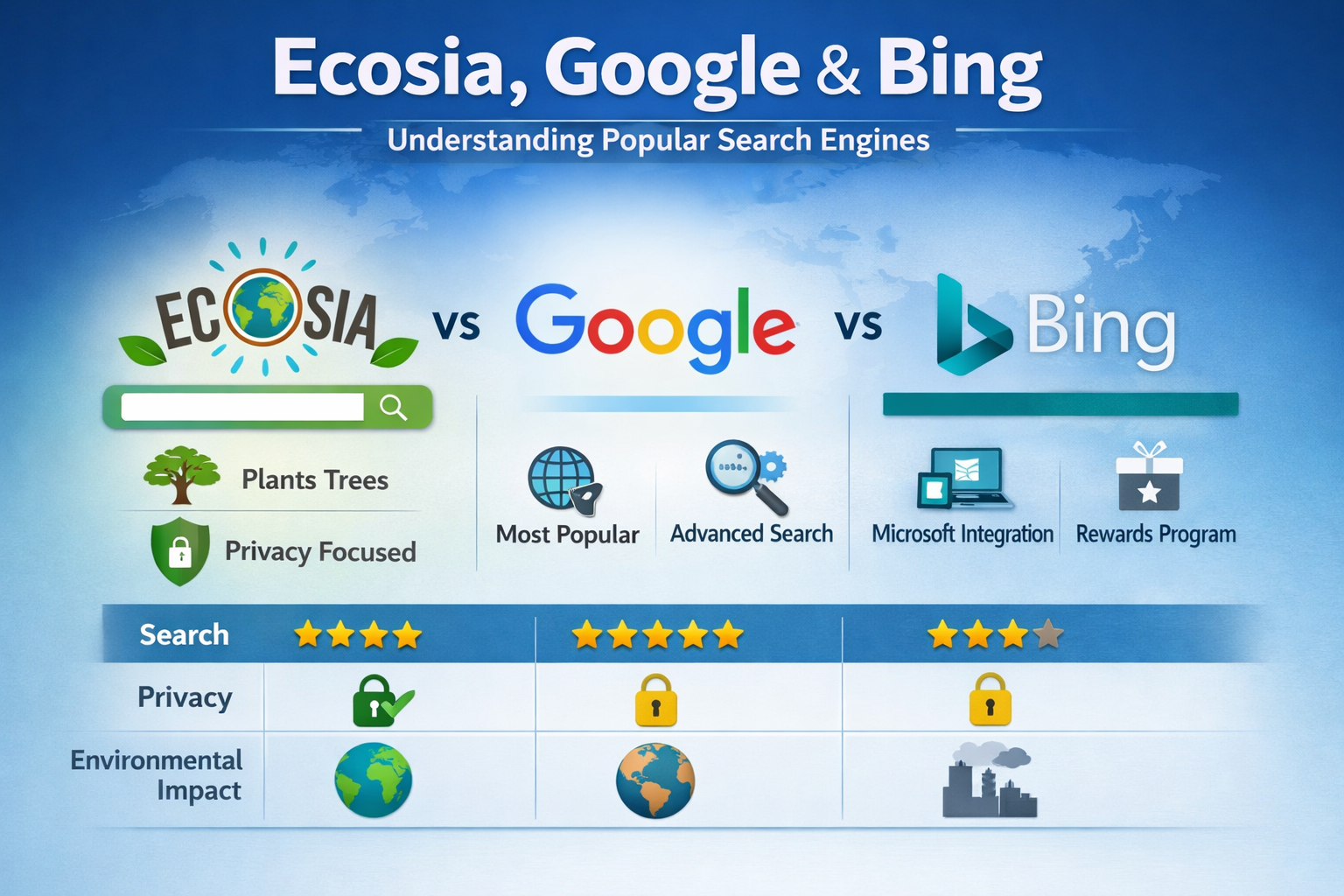



Search engines have become the foundation of how we explore the internet — from looking up answers and definitions, to researching products, news, and local services. But not all search engines are created equal. Google, Bing, and Ecosia represent three very different approaches to search: one prioritizes technology and scale, one focuses on integration with services, and the other champions environmental and ethical goals.
In this section, we’ll break down what each search engine is, how it works, and what makes them distinctive in the crowded world of web search.
What Is a Search Engine?
At its core, a search engine is a software system designed to search for information on the World Wide Web. The results are usually presented as a list of webpages, images, videos, or other pieces of data. Search engines use algorithms to evaluate billions of pages in seconds and return relevant results.
But while the function is similar for all engines, how they operate, what they prioritize, and how they handle user data can be very different.
Google — The Undefeated Leader in Search
Google is the undisputed leader in search, processing more than 90% of all global search queries. Its dominance stems from decades of algorithm innovation, massive infrastructure investment, and integration with tools like Maps, Gmail, Docs, Photos, Drive, and Android.
Key Features of Google
- Advanced Search Algorithms: Google uses highly refined ranking systems that pull results based on relevance, authority, user behavior, and AI enhancements.
- Huge Index: Billions of webpages indexed and constantly updated.
- Rich Results: Answers, featured snippets, maps, news, videos, and real-time data instantly available.
- Ecosystem Integration: Seamlessly integrated with Gmail, YouTube, Maps, Translate, and more.
- AI Tools: Google continues expanding AI-powered assistance in search and related services.
Strengths
✔ Exceptional relevance and depth of search results
✔ Fast global server infrastructure
✔ Wide language support and localization
✔ Deep ecosystem that enhances user experience
Limitations
✘ Heavy tracking and data collection for ad personalization
✘ Often criticized for data privacy concerns
✘ Does not directly contribute profits to social or environmental causes
Google serves a broad range of needs — from casual searches to professional research — but its data-usage model and ad reliance influence how it operates.
Bing — Microsoft’s Answer to Google
Bing is Microsoft’s search engine and the second most recognized search solution after Google. While it holds a much smaller market share (roughly 9% of global desktop searches), it remains widely used — in part due to Windows integration and partnerships across devices and services.
Key Features of Bing
- Uses Microsoft’s own search technologies and ranking systems.
- Provides images, videos, maps, translation tools, and rewards programs.
- Powers other search services (including Yahoo and Ecosia’s results).
- Integrated with Microsoft Edge, Windows search bar, and Microsoft platforms.
Strengths
✔ Strong multimedia search (images/videos)
✔ Integrates with Microsoft products
✔ Modern design and daily background visuals
✔ Decent performance for general queries
Limitations
✘ Smaller index and relevance compared to Google
✘ Less advanced AI and contextual understanding than Google
✘ Bing’s shared infrastructure means privacy practices are tied to Microsoft
Bing remains a competitive choice for everyday search, especially within the Microsoft ecosystem. However, its market share and index depth still trail behind Google’s.
Ecosia — A Search with a Mission
Ecosia is a unique entrant in the search engine world. Launched in 2009 and based in Berlin, Ecosia differentiates itself with a bold mission: use ad revenue from searches to plant trees and support environmental projects.
Core Principles of Ecosia
- Carbon-Negative Searches: Ecosia claims to operate on renewable energy and offsets more carbon than it emits through its projects. Searches are mostly powered by solar energy and its infrastructure invests in clean power.
- Environmental Focus: The majority of profits (roughly 80%) are invested into global tree-planting and ecological restoration projects — contributing to biodiversity, climate mitigation, and community development.
- Privacy: Ecosia holds minimal user data and anonymizes search activity after a short period (typically one week), contrasting with Google’s long-term data storage for advertising purposes.
- Transparency: Monthly financial and environmental reports show exactly how revenue is spent.
How Ecosia Works
- Searches Generate Revenue: Like other engines, Ecosia earns ad revenue when users conduct searches and click on sponsored links.
- Revenue Is Reinvested: After operating costs, income is directed toward tree-planting programs in countries like Brazil, Indonesia, and Ethiopia.
- Trees Store Carbon: New trees help absorb CO₂, support local economies, and restore ecosystems.
Strengths
✔ Environmental impact and sustainability mission
✔ Strong privacy protections relative to mainstream engines
✔ Transparent reporting and B Corp certification
✔ Growing global community of conscious users
Limitations
✘ Relies on Bing’s search infrastructure, meaning results may not be as deep or refined as Google’s.
✘ Smaller market share with less data to refine algorithms.
✘ Ad revenue and tree planting depend on user engagement — fewer searches reduce impact.
Market Share & Usage
Global usage statistics show significant differences:
- Google is dominant with an estimated 90%+ market share.
- Bing holds a modest share in the single digits.
- Ecosia remains a niche player but is growing, especially among environmentally conscious users — handling under 1% of global search requests.
This distribution reflects how entrenched Google is, while Bing remains a viable secondary choice and Ecosia appeals to specific value-based user segments.
Overview: Ecosia and Google
Ecosia and Google represent two contrasting philosophies:
- Google prioritizes technological depth, speed, and integration.
- Ecosia focuses on sustainability, ethical impact, and privacy.
Let’s break down how they compare across key factors.
1. Search Result Quality & Accuracy
Google’s search algorithm is widely considered the most sophisticated in existence. It uses machine learning, vast user behavior signals, and constantly evolving ranking models to generate highly relevant results for nearly any query.
Because of this:
- Users often find answers faster.
- Results include rich formats like snippets, knowledge graphs, and personalized responses.
- Google’s indexing spans billions of pages globally.
Academic studies confirm that Google typically delivers higher relevance and more diverse sources than competitors like Bing.
Ecosia
Ecosia does not independently crawl and index the web. Instead, it relies on Bing’s infrastructure for search results — which are then displayed through its own interface.
This has implications:
- Results tend to be comparable to Bing but not on par with Google’s depth.
- For many general searches, Ecosia is adequate.
- For niche or highly technical terms, Ecosia sometimes returns less relevant output than Google.
Verdict: Google generally outperforms Ecosia in terms of result relevance, speed, and personalization for complex searches.
2. Privacy & Data Handling
Google’s business model revolves around collecting user data to tailor search results and serve targeted ads. This means:
- Searches, click behavior, location, and user preferences can be stored.
- Data is used to personalize both search results and advertising.
While useful for personalized services, this raises privacy concerns for many users.
Ecosia
Ecosia’s privacy approach is fundamentally different:
- It does not create personal profiles from search history.
- Searches are anonymized within a short period (typically about a week).
- No personal data is sold to third parties.
- Ecosia uses HTTPS encryption by default.
This makes Ecosia a strong choice for users concerned about digital privacy.
Verdict: Ecosia offers better privacy protections than Google, especially for users who want minimal tracking.
3. Environmental & Ethical Impact
Google has made commitments to renewable energy use and carbon neutrality. However:
- Its operations are extremely large due to global data centers.
- Environmental contributions are indirect and not tied to specific user actions in search.
Ecosia
Ecosia directly links every search to environmental impact:
- Ad revenue funds tree planting and reforestation worldwide.
- Trees help absorb CO₂ and restore ecosystems.
- Ecosia publishes transparent financial and environmental reports.
For users who want their online activity to support sustainability, Ecosia stands out.
4. Feature Set & Ecosystem Integration
Google’s ecosystem includes:
- Voice search, Maps, Lens, Translate
- Gmail, Drive, Photos, Calendar
- YouTube integration
- Personalized feeds and AI assistance
These features make Google extremely powerful for everyday users.
Ecosia
Ecosia offers basic search features:
- Standard web search
- Image and video search
- Tree counter to show impact
- Mobile apps and browser extensions
But it lacks the extensive ecosystems integrated into Google’s suite.
Verdict: Google offers a richer set of features and deeper integration than Ecosia.
5. Transparency and Reporting
Ecosia publishes monthly reports outlining:
- Ad revenue
- Trees funded
- Financial spending
- Tree-planting progress
Google does not provide equivalent public detail on how its search profits are spent or how they relate to social causes.
Verdict: For transparency on revenue impact, Ecosia leads.
Overview: Ecosia and Bing
Ecosia and Bing are more similar to each other than Ecosia and Google — primarily because Ecosia uses Bing’s search engine technology as the backbone of its result delivery.
What differs is purpose, privacy stance, and mission.
1. Search Technology & Result Quality
Bing
Bing uses Microsoft’s independent search index and ranking algorithms. It is a full-featured search engine with:
- Images, news, maps, and video search
- AI enhancements like Bing Chat and contextual results
- Multi-platform connectivity (Windows, Edge)
In many general searches, Bing performs better than Ecosia simply because its indices are updated and refined continuously.
Ecosia
Ecosia pulls search results from Bing but overlays its own mission and interface.
This means:
- In terms of raw search quality, Ecosia ≈ Bing for most queries.
- Differences arise mainly in presentation and privacy policies.
Verdict: Search results are very similar, but Bing might edge ahead for advanced features and direct Microsoft integration.
2. Privacy Comparison
Bing
Microsoft collects user data to support personalized experiences and ad targeting. While Bing’s privacy stance may be more transparent than Google’s, it still tracks data to power services.
Ecosia
Ecosia’s privacy is stronger in terms of:
- Shorter data retention (anonymized quickly).
- No personal profiles or third-party data selling.
However, since Bing powers Ecosia’s results, some backend data transmission occurs — just without long-term storage.
Verdict: Ecosia is more privacy-centric than Bing.
3. Mission and Social Impact
Bing
Bing does not have an explicit environmental or social mission tied to its search operations.
Ecosia
Ecosia’s core differentiator is its purpose — every query helps fund reforestation and ecological projects.
4. Market Presence
Bing has a more established presence in the search industry due to Microsoft’s ecosystem and partnerships, while Ecosia remains a values-driven but smaller player.
Final Comparison Table
| Feature | Bing | Ecosia | |
| Search Quality | ⭐⭐⭐⭐⭐ | ⭐⭐⭐⭐ | ⭐⭐⭐⭐ (via Bing) |
| Privacy | ⭐⭐ | ⭐⭐⭐ | ⭐⭐⭐⭐ |
| Environmental Impact | ⭐⭐ | ⭐⭐ | ⭐⭐⭐⭐⭐ |
| User Features | ⭐⭐⭐⭐⭐ | ⭐⭐⭐⭐ | ⭐⭐⭐ |
| Ecosystem Integration | ⭐⭐⭐⭐⭐ | ⭐⭐⭐⭐ | ⭐⭐ |
| Transparency | ⭐⭐⭐ | ⭐⭐⭐ | ⭐⭐⭐⭐ |
Conclusion — Which Search Engine Is Better?
There isn’t a one-size-fits-all answer — it depends on what “better” means to you.
Choose Google if:
- You want fast, accurate, and comprehensive results.
- You use a lot of Google services (Maps, Gmail, Drive).
- You prioritize features over privacy or mission.
Choose Bing if:
- You want a solid search engine with good visuals and Microsoft integration.
- You’re comfortable with moderate privacy in exchange for features.
- You like rewards and multimedia tools within search.
Choose Ecosia if:
- You care about the planet and sustainability.
- You want more privacy and minimal tracking.
- You’re willing to trade some advanced search sophistication for social impact.
Final Thoughts
In a world where search drives so much of our digital lives, the choice of engine reflects not just what we want to know, but what we value. Google delivers power and breadth. Bing offers strong alternatives within the Microsoft ecosystem. Ecosia invites us to link everyday actions with global impact.
Whatever you choose, understanding how these engines differ empowers you to make a decision that aligns with your needs — whether it’s performance, privacy, or purpose.
Related Blog: DuckDuckGo Search Engine




What do you think?
It is nice to know your opinion. Leave a comment.