











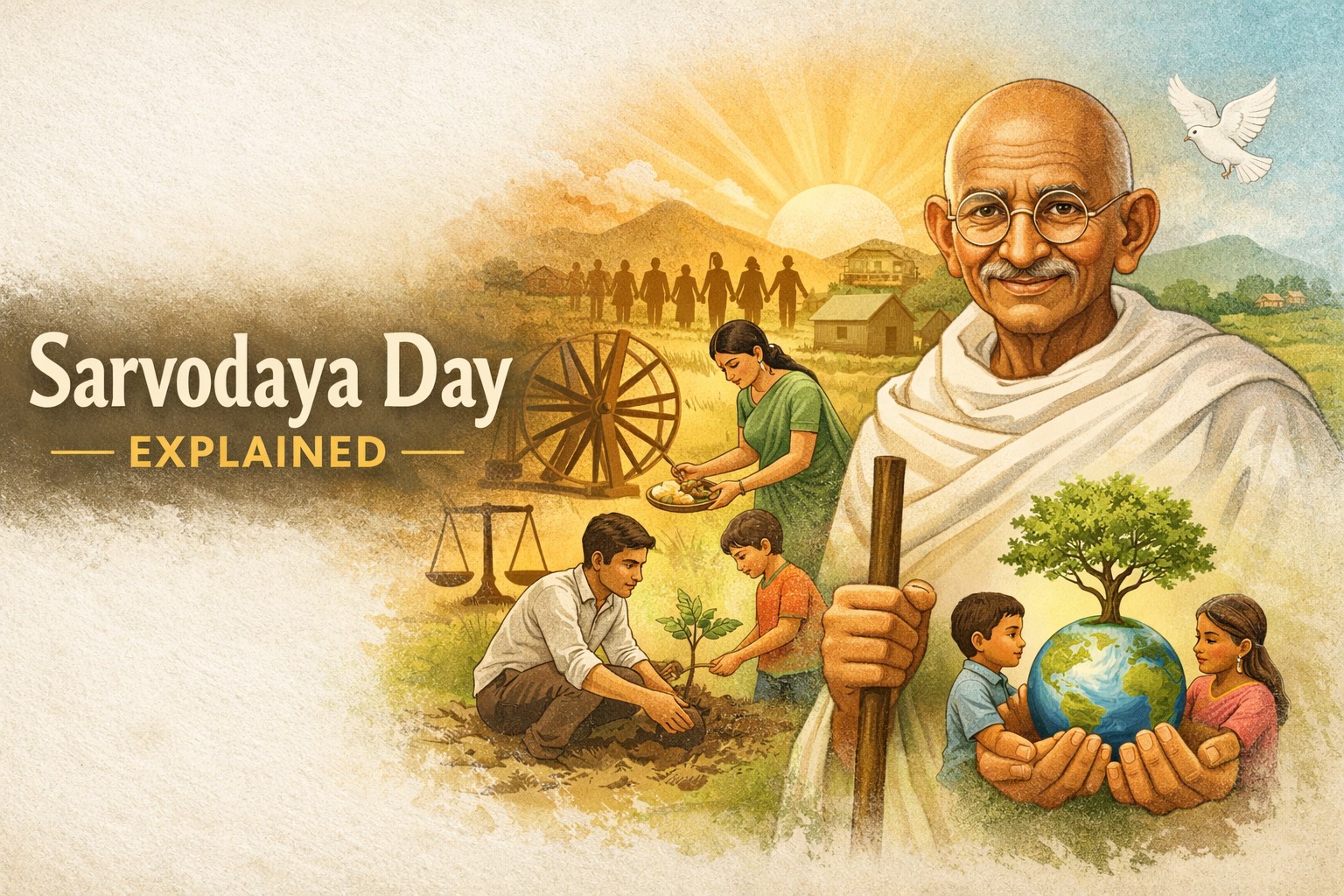



Every year, India observes an important day that is both reflective and inspiring — Sarvodaya Day. This day may not have the same global recognition as some other international observances, but its meaning and message hold deep philosophical and historical importance. Rooted in the principles of peace, equality, and welfare for all, Sarvodaya Day captures the essence of one of India’s greatest thinkers — Mahatma Gandhi — and his timeless vision of a just and harmonious society.
In this article, we will explore what Sarvodaya Day truly means, where it originated, how it is celebrated, its relevance in modern times, and what lessons it offers to the world today. By the end, you’ll understand not just the historical significance of this day but also why it continues to be celebrated with reverence and hope.
What Is Sarvodaya? — The Meaning Behind the Term
To understand Sarvodaya Day, we first need to understand the term Sarvodaya itself.
The Sanskrit word Sarvodaya is derived from two roots — sarva meaning “all” and udaya meaning “rising” or “uplift”. Together, they literally mean “the uplift of all” or the “welfare of all”.
However, its meaning goes far beyond a simple translation. Sarvodaya represents a social and moral philosophy that champions universal wellbeing, equality, dignity for all human beings, and the upliftment of every individual regardless of caste, creed, or status. It is rooted in the belief that true progress is not measured by the success of a few but by the collective advancement of society as a whole.
The term was notably popularized by Mahatma Gandhi, who adopted Sarvodaya as a central pillar of his philosophy of life, freedom, and nation-building. Gandhi saw it as an ideal society where every person would flourish, where exploitation would have no place, and where peace and justice would guide human interactions.
Origins of the Concept: Gandhi and Ruskin’s Influence
The intellectual foundation of Sarvodaya is deeply linked to Gandhi’s encounter with a British book that transformed his life. While living in South Africa as a young lawyer, Gandhi read John Ruskin’s Unto This Last — a critique of modern political economy that emphasized the value of labor, social justice, and human dignity.
Gandhi was so profoundly influenced by the ideas in this book that he translated it into his native Gujarati and titled it Sarvodaya. In doing so, he coined a new term that would come to embody his own socio-political ideals. His interpretation focused not just on economic justice, but on holistic well-being — spiritual, moral, and social — of all individuals in a community.
At its essence, Gandhi’s Sarvodaya stood for:
- Equality and dignity for all human beings, regardless of their social or economic position.
- The good of the individual being contained in the good of all — meaning that one person’s success should not come at the expense of another’s suffering.
- A life of simplicity and labor, valuing all forms of work — intellectual or physical — equally. (
- Nonviolence (Ahimsa) as a guiding principle in personal and collective conduct.
This idea of Sarvodaya was not just abstract philosophy. Gandhi practiced it in everyday life — from how ashrams operated to how the Indian independence movement fought for justice without hate or violence.
Sarvodaya Beyond India: A Movement of Change
Although Sarvodaya is strongly linked with Gandhi and India’s freedom struggle, its influence spread beyond the subcontinent. In Sri Lanka, for example, the Sarvodaya Shramadana Movement became one of the largest civil society movements focused on empowering villages and rural communities through self-help and cooperative development.
Sarvodaya Shramadana combines “Sarvodaya” (welfare for all) with Shramadana (gift of labor), emphasizing selfless community service towards shared wellbeing. This movement has helped rebuild communities, particularly after disasters such as the 2004 tsunami, and continues to be a leading example of grassroots self-reliance and social justice.
This global influence highlights that Sarvodaya is not merely a historical concept — it is a living philosophy that inspires initiatives in social justice, community development, and peaceful coexistence around the world.
What Is Sarvodaya Day? — The Celebration and Its Significance
So, what exactly is Sarvodaya Day?
In India, the term Sarvodaya Day is often associated with Martyrs’ Day, observed on 30 January each year — the day Mahatma Gandhi was assassinated in 1948.
This date is also referred to as Sarvodaya Diwas, because Gandhi lived and sacrificed his life for the welfare of all — the central message of Sarvodaya. Many organizations, schools, and government institutes use this day to reflect on Gandhi’s teachings of nonviolence, compassion, and universal welfare.
The Emotional and Symbolic Importance of Sarvodaya Day
- A Tribute to Gandhi’s Life and Mission: Each year on 30 January, people across India pay homage to Gandhi’s life and values. This is not only about mourning his death but celebrating his legacy of peace, equality, and universal uplift.
- Reflection on Universal Welfare: Events and discussions held on Sarvodaya Day often center on how Gandhi’s ideals can be applied to solve modern problems — from economic inequality to environmental issues.
- Promotion of Nonviolence and Compassion: Many schools and civil society groups organize activities like peace marches, community service drives, and seminars to spread awareness about nonviolence and empathy for all forms of life, including animals. In some states, for example, the day is marked by campaigns encouraging compassion toward animals as part of Gandhi’s principle of “live and let live”.
Rituals and Observances
While Sarvodaya Day is not a public holiday across India, multiple forms of observance take place:
- Wreath-laying ceremonies at Gandhi memorials such as Raj Ghat in New Delhi.
- Two-minute silence observed in memory of Gandhi’s sacrifice and national martyrs.
- All-religion prayers and peace gatherings.
- School programs featuring speeches, plays, and activities conveying the message of universal welfare.
These observances reinforce the central tenet of Sarvodaya — that the true uplift of a nation comes not just through political freedom, but through justice, compassion, and equality for all its people.
Why We Celebrate Sarvodaya Day — Deeper Meaning and Modern Context
Today, the celebration of Sarvodaya Day is more relevant than ever. In a world marked by social divisions, economic inequality, and conflict, the philosophy behind this day offers timeless guidance.
Universal Welfare and Social Justice
Sarvodaya’s core message — welfare for all — stands as a powerful reminder that societies should strive to ensure that no one is left behind. In practical terms, this means:
- Reducing economic inequality.
- Ensuring access to education, healthcare, and basic rights for every citizen.
- Eradicating caste-based discrimination and social exclusion.
These ideals resonate strongly with global efforts toward sustainable development and human rights.
Nonviolence as a Way of Life
Gandhi’s unwavering commitment to nonviolence (ahimsa) was not just a strategy for political struggle, but a moral approach to life. Celebrating Sarvodaya Day encourages individuals and leaders alike to adopt peaceful methods to resolve disputes, promote dialogue, and build communities rooted in empathy and respect.
Self-Reliance and Grassroots Development
Sarvodaya places immense emphasis on empowering communities from the ground up. Gandhi believed that true development should involve local participation, economic self-reliance, and dignity of labor — principles that align with modern ideas of community-driven development.
Continuing the Legacy: Sarvodaya in Today’s World
Although Sarvodaya as a formal movement may not dominate headlines, its philosophical influence continues in many spheres:
- Education: Schools incorporate Gandhi’s values in lessons about empathy, sustainability, and equality.
- Social Work: NGOs and activists draw inspiration from Sarvodaya to design inclusive programs for marginalized communities.
- Environmental Movements: Gandhi’s principle of simple living aligns with contemporary calls for environmental sustainability.
In essence, Sarvodaya is not confined to history; it is a living idea that continues to guide efforts toward justice, harmony, and shared prosperity.
Final Words
Sarvodaya Day is more than just an observance. It is a day to reflect on what it means to live in a society where the welfare of every human being matters. It celebrates universal uplift, nonviolence, equality, and compassion — ideals that M.K. Gandhi held sacred and spent his life promoting.
By understanding and celebrating Sarvodaya Day, we are invited to look beyond political freedom and economic success; we are invited to rethink human relationships, social priorities, and the true meaning of progress — a world where every individual rises, and no one is left behind.
FAQs
What does “Sarvodaya” mean?
Sarvodaya is a Sanskrit word meaning “welfare of all” or “universal uplift” (rise or progress of all). It was popularized by Mahatma Gandhi to describe his philosophy that society’s true progress depends on the well-being of every individual, not just a few.
Why is Sarvodaya important in Gandhi’s philosophy?
Gandhi adopted the term Sarvodaya to represent his vision of a just and equitable society. It stood for nonviolence, simplicity, dignity of labor, equality, and decentralized self-reliant communities. For him, real freedom meant social and moral upliftment for all.
What is Sarvodaya Day?
Sarvodaya Day in India refers to 30 January, also known as Martyrs’ Day or Shaheed Diwas, commemorating the assassination of Mahatma Gandhi in 1948. The day honors Gandhi’s life and work for universal welfare and nonviolence.
Why is Sarvodaya Day celebrated on 30 January?
This date marks the death anniversary of Mahatma Gandhi, who was shot on 30 January 1948. Since Gandhi lived for the uplift and welfare of all, the day is observed as Sarvodaya Day to remember his sacrifice and ideas.
How is Sarvodaya Day observed in India?
Observances often include wreath-laying ceremonies at Gandhi memorials, prayer meetings, moments of silence, peace marches, and discussions about Gandhi’s teachings. Some communities also promote compassion toward living beings and humane values on this day.
Is Sarvodaya only about social welfare?
No. While Sarvodaya emphasizes social welfare, it also includes economic justice, moral upliftment, compassion, equality, decentralization of power, and peaceful coexistence. It seeks holistic development rather than just material progress.
What is the difference between Sarvodaya and Antyodaya?
Sarvodaya means upliftment of everyone, while Antyodaya focuses specifically on the upliftment of the poorest and most marginalized in society — ensuring that the benefits of progress reach the “last person.”
Does the Sarvodaya philosophy have relevance today?
Yes. Sarvodaya’s ideals — equality, compassion, nonviolence, decentralization, and shared prosperity — remain highly relevant in addressing modern issues like social inequality, discrimination, and community empowerment.
Related Blog: List of Bank Holidays in January 2026




What do you think?
It is nice to know your opinion. Leave a comment.