











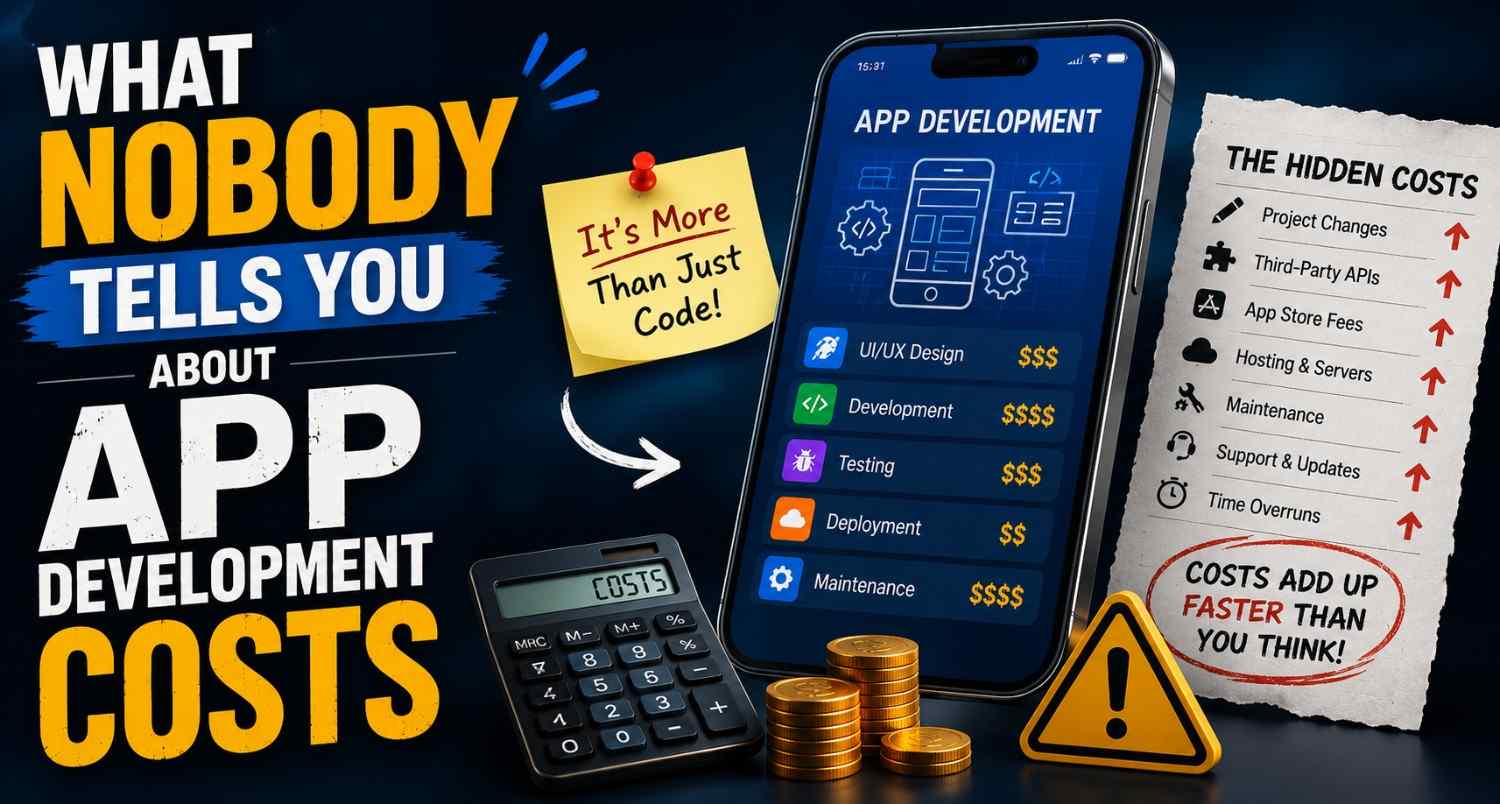



Everyone who has ever built a mobile app remembers the moment their excitement turned into dread. Not when the app failed — but when the invoices kept arriving long after the launch party was over.
You budgeted for development. You budgeted for design. You maybe even budgeted for marketing. But nobody told you about the App Store renewal fees, the backend infrastructure that scales with your users, the emergency hotfix that costs as much as a month of development, the customer support tool you cannot live without, the legal compliance audit that your enterprise client requires before they sign — or the quiet, relentless drain of just keeping a live app alive.
This is the guide that nobody gives you before you start. It is not here to discourage you — mobile apps remain one of the most powerful business investments you can make. It is here to make sure you go in with open eyes, a realistic budget, and a plan that does not fall apart six months after launch.
Let us break down every hidden cost of building a mobile app, explain why it exists, give you real numbers, and show you how to manage each one strategically.
“The app itself is just the ticket to the game. The ongoing costs are the actual price of playing.”
1. The Build Cost Illusion: Why Your Development Quote Is Just the Beginning
Most founders and product managers focus almost entirely on the initial build cost. A development agency quotes you ₹15–50 lakhs (or $20,000–$80,000) to build your app. You budget for it, sign the contract, and consider the financial planning done.
Here is the problem: that quote covers only one phase of what is actually a perpetual product lifecycle. The build is the smallest financial commitment you will make relative to the total cost of ownership over three to five years.
Industry research consistently shows that the total cost of owning and operating a mobile app over its lifetime is typically 3 to 5 times the initial development cost. A ₹20 lakh build can easily become a ₹80–100 lakh commitment over five years when all ongoing costs are factored in.
Why the initial quote always underestimates the real cost
- Quotes are scoped to the MVP — the minimum viable product — not the production-grade, maintained, secured, and scaled version
- Backend infrastructure is often excluded or underestimated at the proposal stage
- Third-party service integrations are quoted as one-time setup costs, not recurring annual expenses
- Post-launch support, updates, and OS compatibility work is rarely itemised in initial contracts
- Scope creep during development — which happens in virtually every project — adds 20–40% to the original quote on average
PRO TIP: Before signing any development contract, ask the agency to provide a 3-year total cost of ownership estimate — not just the build quote. Any reputable partner should be able to do this.
2. App Store and Platform Fees: The Annual Toll Nobody Warns You About
The moment you decide to publish your app, you enter into a financial relationship with Apple and Google that never ends. These platform fees are non-negotiable, non-waivable, and they are just the beginning of your platform cost exposure.
Apple Developer Program
Apple charges $99 per year (approximately ₹8,250 at current rates) for an individual or organisation developer account. Miss this renewal and your app is immediately removed from the App Store — for all existing users. You cannot publish updates, respond to crashes, or push critical security patches until the fee is paid and the account reinstated.
For enterprise distribution (apps distributed internally without the App Store), Apple charges $299 per year.
Google Play Developer Account
Google charges a one-time registration fee of $25 (approximately ₹1,660). While this is far more affordable than Apple’s recurring model, Google has its own cost considerations — particularly around their in-app purchase commission structure and the growing requirements for app content policy compliance audits.
In-App Purchase Commission
This is the hidden cost that has launched a thousand lawsuits. Both Apple and Google take a 30% commission on all in-app purchases and subscriptions for apps in their stores. For apps generating revenue through digital goods or subscriptions, this commission directly and significantly affects your margins. For the first year of a subscription, the rate drops to 15% on iOS — but that is still a substantial platform tax on every rupee of revenue.
If your app generates ₹10 lakh per month in subscription revenue, you are handing ₹1.5–3 lakh of that directly to Apple or Google every single month.
“Platform commissions are not a line item most founders model into their unit economics — until the first reconciliation statement arrives.”
STRATEGY: If your app has a web equivalent, consider offering subscriptions through your website instead of in-app where possible. Web purchases bypass the 30% commission entirely — a strategy used by Spotify, Netflix, and many others.
3. Backend Infrastructure and Cloud Hosting: The Cost That Scales With Your Success
Your mobile app is only the visible layer. Underneath it sits a backend infrastructure — servers, databases, APIs, storage, and networking — that keeps everything running. This infrastructure costs money every month, and it costs more money as your user base grows.
This creates a counterintuitive situation: your costs go up precisely when your product is succeeding. If you have not modelled this correctly, rapid user growth can become a financial crisis rather than a celebration.
What backend infrastructure typically includes
- Application servers (handling API requests from your mobile app)
- Databases (PostgreSQL, MongoDB, Firebase — storing user data, transactions, content)
- Object storage (AWS S3 or equivalent — storing images, videos, documents uploaded by users)
- CDN (Content Delivery Network — serving content quickly to users across geographies)
- Load balancers (distributing traffic across multiple servers during peak usage)
- Background job processors (sending emails, processing payments, generating reports)
- Monitoring and alerting systems (detecting downtime or performance degradation)
Realistic hosting cost ranges
For a small app with under 5,000 monthly active users: ₹8,000–25,000 per month on AWS, GCP, or Azure.
For a medium app with 10,000–50,000 monthly active users: ₹25,000–1 lakh per month, depending on data intensity and feature complexity.
For a large app with 100,000+ monthly active users: ₹1–5 lakh per month and upward, with costs highly dependent on whether the app handles video, real-time features, or complex computations.
WATCH OUT: Many early-stage apps start on low-cost shared hosting or free tiers of cloud platforms, then face a sudden, unplanned cost spike when they scale. Model your infrastructure costs at 10x your current user base before launch.
4. Third-Party API and Service Subscriptions: Death by a Thousand Integrations
Modern mobile apps are not built in isolation — they are assembled from dozens of third-party services, each with their own pricing model, usage limits, and renewal cycles. Individually, each seems affordable. Collectively, they become a significant monthly overhead that grows with your product’s sophistication.
The most common third-party costs
Payment gateway fees
Razorpay, Stripe, and PayU typically charge 2–3% per transaction plus a fixed fee. On ₹10 lakh of monthly GMV, you are paying ₹20,000–30,000 in gateway fees alone. This is not a subscription — it scales directly with your revenue, which means it never goes away.
Maps and location services
Google Maps Platform charges per API call beyond its free tier. An app using maps for location search, route calculation, or address auto-complete can easily exceed the free tier within weeks of launch. Expect ₹10,000–80,000 per month for a maps-intensive app.
Push notifications
Firebase Cloud Messaging (FCM) has a generous free tier. However, premium services like OneSignal, Braze, or CleverTap — which offer advanced segmentation, A/B testing, and analytics — start at ₹5,000–30,000 per month and scale with your user count.
SMS and OTP verification
If your app uses phone number verification (and most Indian apps do), you are paying per SMS. Twilio, MSG91, and similar services charge ₹0.15–0.50 per OTP message. At 10,000 new user registrations per month, that is ₹1,500–5,000 in OTP costs alone — before accounting for login re-verifications.
Authentication and identity
Auth0, Firebase Authentication, and similar services handle user login, social sign-on, and session management. Free tiers cover early stages, but paid tiers begin at $23–$240 per month and scale significantly with monthly active users.
Email service
Transactional emails (receipts, password resets, notifications) require services like SendGrid, Mailchimp Transactional, or AWS SES. Costs range from ₹2,000–20,000 per month depending on volume.
“Each third-party integration feels like a small decision. But 15 small decisions at ₹5,000/month each is ₹75,000/month in ongoing overhead before you write a single line of new code.”
5. App Maintenance and Updates: The Invisible Full-Time Job
The most dangerously underestimated cost in mobile app development is maintenance. Many founders treat the app as a finished product after launch. In reality, a live mobile app is a living system that requires constant attention — not because of your choices, but because of decisions made by Apple, Google, device manufacturers, and the broader technology ecosystem.
OS updates and compatibility
Apple releases a major iOS update every September. Google releases major Android updates throughout the year. Each update can break existing features, change APIs your app depends on, or introduce new requirements (permissions, UI patterns, privacy labels) that must be implemented before the next submission.
Failing to update for OS compatibility means your app crashes on the latest devices — the devices your most active, highest-value users tend to have.
App Store policy compliance
Apple and Google update their developer policies regularly. In recent years, requirements have been introduced around privacy labels, App Tracking Transparency, data deletion requests, and minimum SDK versions. Non-compliant apps are rejected from update submissions — meaning you cannot ship any new feature or bug fix until the compliance issue is resolved.
Bug fixes and crash resolution
No app launches without bugs. User behaviour in the real world is always more varied and unpredictable than testing environments can simulate. Post-launch bug fixes are a guaranteed cost — typically representing 15–25% of the initial build cost in the first year alone.
Device and screen fragmentation (Android)
Android runs on thousands of different devices with different screen sizes, processors, camera configurations, and Android versions. Testing and fixing for device fragmentation is an ongoing cost unique to the Android ecosystem and is consistently more expensive than iOS maintenance.
What maintenance typically costs
A lean maintenance retainer with a development agency for a medium-complexity app: ₹30,000–75,000 per month. A dedicated in-house junior developer for maintenance: ₹25,000–60,000 per month in salary. An unplanned emergency hotfix for a critical production bug: ₹15,000–80,000 depending on complexity and urgency.
PRO TIP: Budget 20% of your initial development cost annually for maintenance. If your app cost ₹30 lakhs to build, budget ₹6 lakhs per year for maintenance — before adding new features.
6. Security, Compliance, and Legal Costs: The Costs That Protect You From Bigger Costs
In the early days of mobile apps, security and compliance were afterthoughts. In 2026, they are existential concerns — particularly if your app handles user data, processes payments, operates in regulated sectors, or has enterprise clients.
SSL certificates and HTTPS
Your app’s backend must be served over HTTPS. SSL certificates range from free (Let’s Encrypt) to ₹5,000–20,000 per year for extended validation certificates that some enterprise clients require. Automated certificate renewal is essential — an expired certificate takes your entire backend offline instantly.
Data protection compliance (DPDP Act)
India’s Digital Personal Data Protection Act (2023) places real obligations on apps that collect user data — which means virtually every app. Compliance requires a privacy policy, data processing agreements with third-party vendors, a data deletion mechanism for users, and documented consent flows. Getting this right typically requires at minimum 10–15 hours of legal counsel: ₹15,000–50,000 as a one-time investment, with annual reviews required as the law evolves.
GDPR (if you have European users)
If any of your users are in the European Union, GDPR applies — regardless of where your company is incorporated. The compliance requirements are extensive: cookie consent management, right to erasure, data portability, breach notification within 72 hours. A proper GDPR compliance review for a medium-complexity app costs ₹50,000–2,00,000 from a qualified legal consultant.
PCI DSS compliance (if you handle card payments)
Payment Card Industry compliance is mandatory if your app processes card payments without fully outsourcing the process to a compliant gateway. Using Razorpay or Stripe’s hosted payment pages largely handles this for you — but any custom payment UI or stored card data creates significant compliance obligations and associated costs.
Security penetration testing
Enterprise clients and regulated industries increasingly require documented security audits before onboarding a new software vendor. A basic mobile app penetration test costs ₹50,000–2,00,000 from a qualified security firm. Enterprise-grade audits with written reports can reach ₹5,00,000+.
7. Customer Support Infrastructure: The Cost of Having Real Users
Before launch, customer support seems simple — you will just reply to emails. After launch, with real users experiencing real problems in real time, this approach collapses within weeks. The cost of customer support infrastructure is one of the most consistently underestimated line items in any mobile app budget.
Support tooling
Intercom, Freshdesk, Zendesk, and similar customer support platforms start at ₹1,500–5,000 per agent per month. For a small team of two support agents, that is ₹3,000–10,000 per month just for the software. At scale, these costs grow significantly.
In-app chat and help centres
Users expect to be able to find help without leaving the app. In-app help centres, chatbots, and live chat widgets require integration with your support tooling — and many platforms charge additional fees for the mobile SDK on top of the base subscription.
Support staffing
If your app has 10,000+ monthly active users, at least a part-time customer support resource is typically necessary. A junior support executive: ₹15,000–25,000 per month. The cost of not having one: negative reviews, low ratings, and app uninstalls that cost you far more in lost revenue.
App Store rating management
Your app’s rating on the App Store and Play Store directly affects download conversion rates. Apps below 4.0 stars see measurably lower organic downloads. Maintaining a good rating requires actively soliciting reviews, responding to negative feedback, and resolving issues quickly — all of which require time and tooling investment.
8. Marketing and User Acquisition: The Cost of Being Found
Building the app is only half the equation. Getting users to find it, download it, and stay is an entirely separate financial commitment that many first-time app builders fail to budget for adequately.
App Store Optimisation (ASO)
Unlike the web, where SEO is well understood, App Store Optimisation — the practice of optimising your app’s listing to appear in relevant searches — is a specialised discipline. A professional ASO audit and strategy: ₹20,000–60,000. Ongoing ASO management: ₹10,000–40,000 per month.
Paid user acquisition
Organic installs are wonderful. They are also insufficient for most apps that need to reach scale quickly. Meta Ads, Google App Campaigns, and Apple Search Ads are the primary paid channels. Cost-per-install (CPI) in India currently ranges from ₹15–80 for broad audiences, and ₹80–300+ for targeted, high-intent segments. Acquiring 10,000 quality users through paid channels can cost ₹1.5–30 lakhs, depending on your category and targeting.
Influencer and content marketing
For consumer apps in India, influencer marketing on Instagram, YouTube, and increasingly on ShareChat and Moj offers strong returns. Micro-influencer campaigns (10,000–100,000 followers) cost ₹5,000–50,000 per creator per campaign. A meaningful influencer campaign requires 5–10 creators minimum to generate measurable impact.
“Most apps spend 10x their marketing budget on development and 0.1x their development budget on marketing — and then wonder why nobody downloads it.”
9. Analytics, Monitoring, and Business Intelligence: The Cost of Knowing What’s Happening
You cannot improve what you cannot measure. But measuring everything costs money — and the tools that give you genuinely actionable data are rarely free at any meaningful scale.
Crash reporting
Firebase Crashlytics is free and excellent for crash reporting. Sentry offers more detailed error tracking and starts at $26 per month for teams. For apps where reliability is critical (fintech, healthcare, commerce), Sentry or Datadog are worth the investment.
Product analytics
Google Analytics for Firebase is free but limited. Mixpanel, Amplitude, and Heap offer behavioural analytics — funnel analysis, retention cohorts, feature usage tracking — that are essential for product decision-making. Mixpanel’s paid plans start at $28 per month. Amplitude starts at $995 per month at scale. For early-stage apps, the free tiers of both are generous and usable.
User session recording
Tools like UXCam and FullStory record actual user sessions — showing you exactly how users interact with your app, where they get confused, and where they drop off. UXCam starts at approximately $14 per month. This category of tooling has an extraordinarily high return on investment when used to inform UX improvements.
Business intelligence and reporting
As your app generates data, stakeholders will want dashboards, reports, and insights. Building custom BI tooling is expensive. Connecting Metabase, Tableau, or Looker to your database costs ₹0 (Metabase open-source) to ₹25,000+ per month (Tableau). Budgeting for this infrastructure early saves significant retrospective engineering cost.
10. Scaling Costs: When Success Creates Its Own Financial Crisis
This is the hidden cost that no one anticipates because it only arrives when things are going well — and it can feel like a punishment for success if you are not prepared for it.
Database scaling
Relational databases like PostgreSQL and MySQL perform beautifully at small scale. At 100,000+ records with complex queries, they require optimisation, indexing strategies, read replicas, and eventually sharding — all of which require specialist engineering time. A database performance engagement with a specialist: ₹50,000–2,00,000.
CDN and global expansion
If your user base grows internationally, serving content quickly to users in different geographies requires CDN expansion. AWS CloudFront, Cloudflare, and Fastly scale costs with bandwidth and request volume. An app serving video content to users across India and internationally can reach ₹50,000–3 lakh per month in CDN costs alone.
Team scaling
The most significant scaling cost is human capital. An app that started with one developer and one designer quickly needs a backend engineer, a DevOps engineer, a QA specialist, a product manager, and a data analyst as it grows. Each hire adds ₹40,000–1,50,000 per month in salary — and recruiting, onboarding, and management overhead on top of that.
The technical debt tax
Apps built quickly to validate an idea accumulate technical debt — shortcuts, temporary solutions, and architectural decisions that worked at small scale but create compounding problems at larger scale. Refactoring technical debt is expensive: typically 3–6 months of senior engineering time for a medium-complexity app. Companies that do not invest in this eventually find that new feature development slows dramatically as engineers spend more time working around old problems than building new capabilities.
11. The Complete Hidden Cost Reference Table
Use this table as a starting point for your real financial modelling. All figures in INR and USD ranges for reference.
| Hidden Cost | Typical Range | Notes |
| App Store fees (annual) | ₹8,250 / $99 | Required for iOS |
| Play Store (one-time) | ₹1,660 / $25 | One-time |
| SSL Certificate | ₹5,000–20,000/yr | Essential |
| Cloud hosting (AWS/GCP) | ₹25,000–2L/yr | Scales with users |
| Third-party APIs | ₹10,000–1L/yr | Maps, payments, auth |
| QA & testing tools | ₹15,000–60,000/yr | Crashlytics, TestFlight |
| Push notification service | ₹5,000–30,000/yr | OneSignal, Firebase |
| Analytics platform | ₹0–50,000/yr | Mixpanel, Amplitude |
| Customer support tool | ₹12,000–80,000/yr | Intercom, Freshdesk |
| App updates (quarterly) | ₹50,000–2L/yr | Dev cost post-launch |
NOTE: These are indicative ranges. Actual costs depend heavily on your app category, user base size, geography, feature complexity, and chosen technology stack. Always get specific quotes for your situation.
12. How to Budget for Hidden Costs: A Practical Framework
Now that you understand what you are actually signing up for financially, here is a practical framework for building a budget that does not collapse six months after launch.
The 3x rule
Take your initial development quote and multiply it by 3. That is a rough estimate of your total cost of ownership over the first three years. If the development quote is ₹30 lakhs, budget ₹90 lakhs total over three years before expecting the app to be financially self-sustaining.
Build your recurring cost stack before you build your app
Before writing a single line of code, list every third-party service you plan to use, research their pricing, and model your monthly recurring cost at three different user scales: 1,000 MAU, 10,000 MAU, and 100,000 MAU. This exercise reveals scaling cost cliffs before they become crises.
Establish a maintenance reserve
Set aside 20% of your development budget in a maintenance reserve before launch. Treat this as a non-negotiable financial discipline — not a cost to be optimised away. It will be used. The only question is whether it is there when needed.
Negotiate annual contracts where possible
Most SaaS tools offer 20–40% discounts on annual billing vs. monthly billing. For services you are confident you will use for at least 12 months, annual contracts significantly reduce your total cost of ownership.
Audit your tool stack every six months
Subscription costs accumulate silently. Set a calendar reminder every six months to review every third-party service you are paying for, confirm it is being used, and evaluate whether a cheaper alternative exists or whether the service can be eliminated entirely.
Conclusion: The App Is Just the Beginning — Plan for the Journey
Building a mobile app is one of the most exciting business decisions you can make. It is also one of the most financially complex ones — not because the individual costs are large, but because they are numerous, persistent, and deeply interconnected.
The founders and companies that succeed with mobile apps are not the ones who spent the least. They are the ones who planned the most thoroughly — who understood that the build cost was the starting line, not the finish line, and who designed their financial model around the full lifecycle of a live, evolving product.
Every cost in this guide is manageable. None of them are dealbreakers. But all of them need to be in your spreadsheet before you sign your development contract — not discovered one by one as surprise line items after launch.
“Build with open eyes. The hidden costs are only hidden until someone shows you where to look.”
If you are planning a mobile app and want a realistic total cost of ownership model for your specific idea, speak to our team. We have helped over [X] businesses build apps that are profitable, maintainable, and built to last — with no unpleasant financial surprises along the way.




What do you think?
It is nice to know your opinion. Leave a comment.