











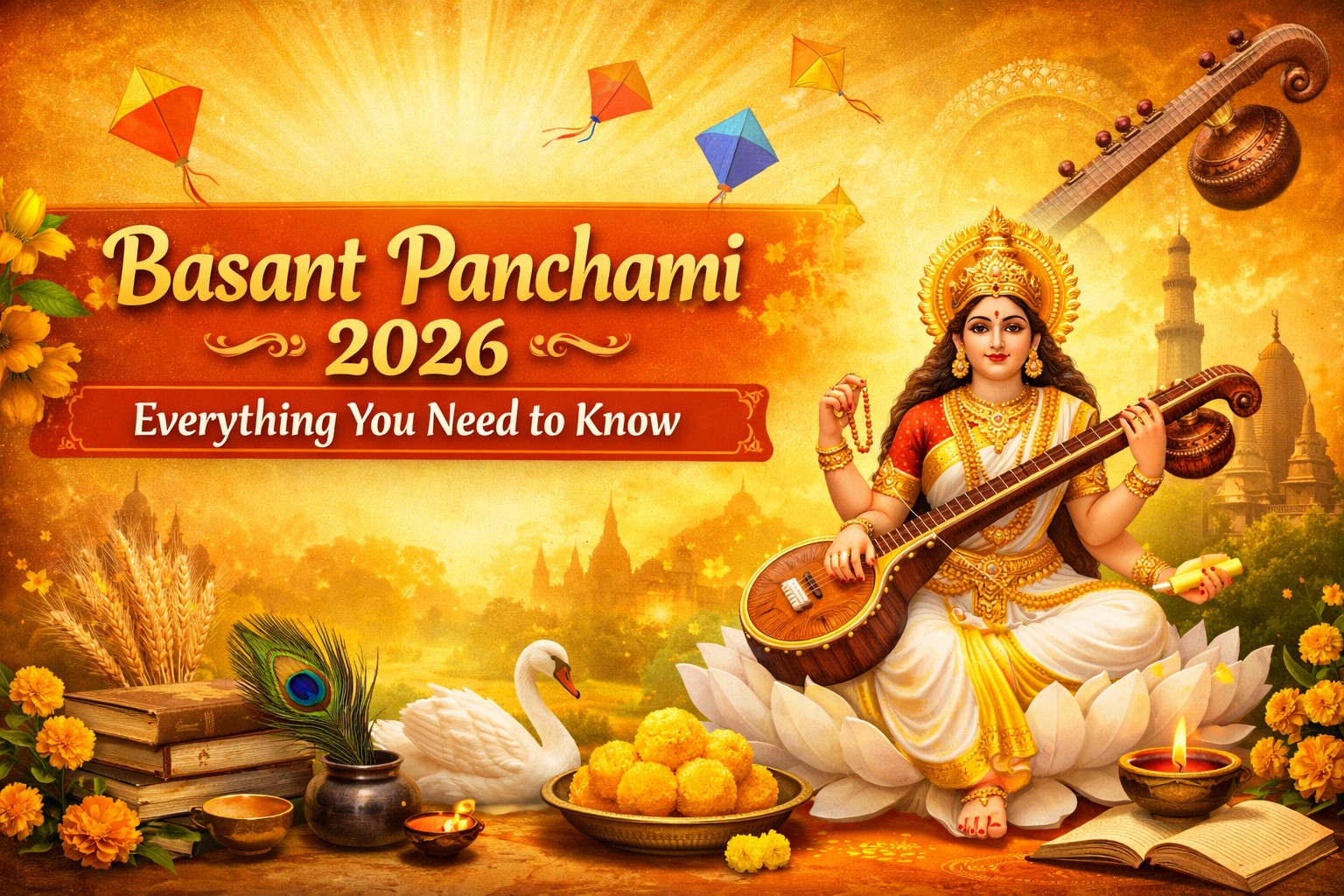



Every year, as winter begins to wane and a golden hue spreads over fields and skies, Hindus across India and around the world prepare to celebrate one of the most spiritually meaningful festivals of the year — Basant Panchami 2026. Also known as Vasant Panchami, this treasured festival marks the onset of spring (vasant ritu), celebrates the Goddess of knowledge and wisdom, and invites people to embrace learning, creativity, and inner illumination. Central to the observance is the revered ritual of saraswati puja 2026, where devotees seek the blessings of Goddess Saraswati for wisdom, artistic talents, and academic success.
In this post, we’ll explore the basant panchami 2026 date, its deep cultural and spiritual meaning, the traditional saraswati puja 2026 rituals, significance across regions, beautiful celebrations, and how devotees observe this auspicious day.
What Is Basant Panchami?
Basant Panchami—also called Vasant Panchami — is a vibrant Hindu festival that marks the arrival of spring and celebrates knowledge, wisdom, and the arts. The word “Basant” (or Vasant) means “spring” in Sanskrit and Panchami signifies the fifth day of the lunar fortnight, as the festival is observed on the fifth day of the bright half (Shukla Paksha) of the Hindu month of Magha.
At its heart, Basant Panchami honors Goddess Saraswati, the divine embodiment of knowledge, music, arts, speech, and learning. Across India, people celebrate by offering prayers, decorating spaces with vibrant hues of yellow, and embarking on new personal and educational journeys under her benevolent grace.
Basant Panchami 2026 Date & Time
For the year 2026, basant panchami 2026 will be celebrated on Friday, January 23, 2026. This date is confirmed by traditional Hindu calendars because the Panchami Tithi (lunar day) overlaps with the daytime on January 23, making it the appropriate day for festivities according to ancient observance rules.
While the Panchami Tithi technically extends into early morning of January 24, Hindu traditions emphasize the tithi prevailing at sunrise, which falls on January 23, 2026 — hence the observance on this date.
Saraswati Puja Muhurat — Ideal Time
A key part of the celebration is saraswati puja 2026, and the most auspicious time to perform this sacred worship is typically in the morning hours between 7:15 AM and 12:50 PM on January 23, when the Panchami Tithi is active.
Devotees often plan their morning rituals accordingly, waking up before sunrise to greet the day’s spiritual energy and perform the puja early.
Meaning & Spiritual Significance
Celebration of Spring
At its core, Basant Panchami is a festival that heralds the beginning of spring — a season symbolizing renewal, hope, freshness, and growth. The mustard fields turn golden across northern India, the mild breeze carries warmth, and nature bursts into life. Yellow — the color of spring’s first blossoms — becomes synonymous with the festival.
The rich yellow of mustard petals, traditional clothes, marigold decorations, and halwa desserts creates a mesmerizing tableau, inviting devotees to reflect on rejuvenation, joy, and potential.
Honoring Knowledge and Learning
In Hindu tradition, Goddess Saraswati is revered as the Vagdevi — the goddess of speech, wisdom, and the creative arts. She holds in her four hands:
- The Veena (symbol of arts and music),
- Sacred Vedas (symbol of knowledge),
- A rosary (mala — symbol of meditation and spirituality),
- And a white lotus (symbol of purity and enlightenment).
Devotees believe that sincere worship on this day brings clarity of thought, sharpness of intellect, and success in scholarly and artistic endeavors.
For students, artists, writers, and learners of all ages, saraswati puja 2026 is an opportunity to invite divine wisdom into their pursuits.
Auspicious Beginnings
Traditionally, any new learning activity — from initiating a child’s formal education (Vidyarambh) to starting a musical instrument — is warmly welcomed on Basant Panchami. The day’s auspiciousness makes it ideal for fresh starts and positive intentions.
Saraswati Puja 2026 — Rituals & Traditions
Idol or Picture of Goddess Saraswati
The centerpiece of saraswati puja 2026 is the idol or picture of Goddess Saraswati placed on an altar. This is adorned with garlands of yellow flowers and strands of marigold, creating a sacred space filled with devotion.
Wearing Yellow and Decorations
Yellow is the festival’s defining color — signifying knowledge, brightness, and prosperity. On this day:
- Devotees wear yellow garments or bright attire.
- Homes and puja spaces are decorated with yellow flowers.
- Yellow sweets like kesari halwa, boondi laddoo, and saffron rice are offered to the goddess.
Children often bring their school books, pens, and musical instruments to the puja area so that at the end of worship, they can invoke Saraswati’s blessings for a successful year of learning.
Chanting Mantras & Prayers
Devotees chant verses and mantras like:
“ॐ ऐं सरस्वत्यै नमः”
(Om Aim Saraswatyai Namah)
These chants create an atmosphere of devotion and focus, inviting clarity, purity of thought, and inner discipline.
Ritual Offerings (Prasad)
Offerings in saraswati puja 2026 typically include:
- Yellow flowers,
- Fresh fruits like bananas and apples,
- Sweets and light dishes colored saffron or turmeric,
- Incense sticks and ghee lamps.
After offering to the goddess, these are distributed among family members as prasadam, symbolizing shared blessings.
Regional Celebrations Across India
North India — Kite Flying & Festive Spirit
In places like Punjab, Haryana, and Uttar Pradesh, Basant Panchami is synonymous with kite flying festivals. The sky fills with colorful kites, and friends and families gather on rooftops to compete and celebrate spring’s onset.
West Bengal & East India — Elaborate Saraswati Puja
In West Bengal, Assam, and Odisha, saraswati puja 2026 reaches grand cultural heights. Schools, colleges, community clubs, and homes organize elaborate pujas, cultural dance programs, music competitions, and poetry recitals — all dedicated to the goddess of learning.
Temples and Cultural Programs
Many temples across India hold special pujas, recitations, and classical music performances. Local fairs (melas) and community feasts enhance the festive spirit, weaving both devotion and joy into the celebration.
Cultural Impact and Modern Relevance
Beyond its spiritual and seasonal aspects, basant panchami 2026 plays an important role in today’s cultural landscape:
- Schools and universities often schedule special programs celebrating literature, science, art, and music.
- Competitions in public speaking, painting, and drama highlight the creative talents of young minds.
- Social media campaigns and hashtag movements spread awareness about wisdom, education, and spring’s beauty.
For many communities, Basant Panchami is a day when tradition and modern aspirations come together — a reminder that knowledge and creativity are timeless pursuits.
Symbolism of Yellow in Basant Panchami
The predominance of yellow is not just aesthetic; it carries deep symbolic meaning:
- Yellow reflects the blooming mustard fields that herald spring.
- It represents energy, positivity, growth, and mental clarity.
- In spiritual terms, yellow aligns with the solar energy, intellect, and prosperity.
Because of this, devotees wear yellow clothes, offer yellow flowers, and serve yellow food, hoping to invoke these qualities in their lives.
How to Observe Basant Panchami 2026 Meaningfully?
Here are practical ways readers can observe this auspicious day:
Set Up a Puja Altar
Create a sacred space at home with an idol or image of Goddess Saraswati, yellow flowers, and offerings.
Offer Books & Instruments
If you have school books, musical instruments, or tools of creative expression, place them near the altar to receive divine blessings.
Wear Yellow Clothing
Choose yellow or bright attire to honor the spirit of spring and symbolically welcome joy and vitality.
Reflect on New Beginnings
Use Basant Panchami as a moment for introspection — setting goals related to education, creativity, or personal growth.
Conclusion
Basant Panchami 2026 stands as an inspiring blend of seasonal change, spiritual reverence, cultural vibrancy, and personal renewal. Through saraswati puja 2026, devotees invite the wisdom of Goddess Saraswati into their lives, seeking blessings for academic success, artistic expression, and spiritual depth.
As the golden hues of spring spread across landscapes and hearts, Basant Panchami invites us all to celebrate the joy of learning, the beauty of creativity, and the promise of new beginnings.
May this vasant panchami 2026 bring you insight, inspiration, and abundant blessings!
FAQs
When is Basant Panchami 2026 celebrated?
Basant Panchami 2026 will be observed on 23 January 2026 (Friday), as per the Hindu lunar calendar. The Panchami tithi starts late on the night of 23 January and continues into early 24 January, but the festival is traditionally marked on 23 January.
What is saraswati puja 2026 and why is it significant?
Saraswati puja 2026 is the ritual worship of Goddess Saraswati, the Hindu deity of knowledge, wisdom, music, and arts. Devotees pray for academic success, creative inspiration, and intellectual growth.
What is the best time (muhurat) for Saraswati Puja on Basant Panchami?
The most auspicious time for saraswati puja 2026 is in the morning hours, typically from around 7:15 AM to early afternoon on 23 January, when the Panchami tithi is active.
Why is yellow associated with vasant panchami 2026?
Yellow is symbolic of spring’s arrival, energy, and prosperity. People wear yellow clothes, decorate with yellow flowers, and prepare yellow foods like saffron rice and sweets as offerings.
Can children start their education on Basant Panchami?
Yes — vasant panchami 2026 is considered an auspicious day for children to begin their learning journey (Vidyarambh) by writing their first letters or books.
Is Basant Panchami a celebration of season as well?
Along with spiritual significance, Basant Panchami also marks the beginning of spring — a time of warmer weather, blooming flowers, and renewed life.
Related Blog: Basant Panchami Wishes, Messages, and Greetings




What do you think?
It is nice to know your opinion. Leave a comment.