











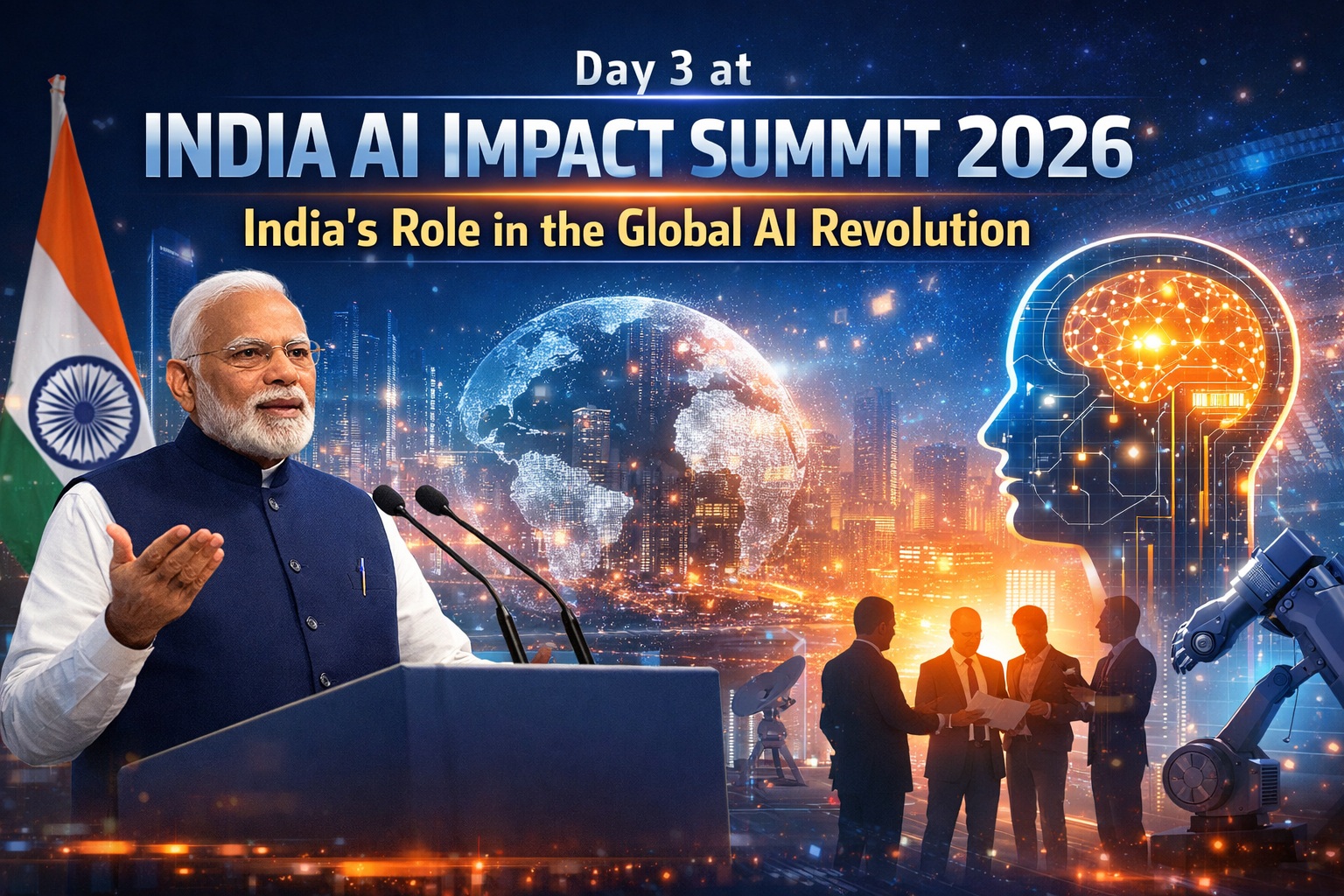



Artificial Intelligence is no longer a futuristic concept discussed only in research labs or Silicon Valley boardrooms. It is rapidly becoming the backbone of economic growth, governance reform, industrial automation, healthcare innovation, and digital inclusion worldwide. At the India AI Impact Summit 2026 in New Delhi, this reality took center stage. Day 3 of the summit emerged as one of the most significant moments of the event, with Prime Minister Narendra Modi outlining India’s long-term vision for becoming a global AI powerhouse while ensuring that technology remains inclusive, ethical, and human-centric.
The summit, attended by policymakers, global tech leaders, researchers, entrepreneurs, and investors, positioned India not merely as a participant in the AI race but as a serious contender shaping its direction. On Day 3, the Prime Minister’s address focused on India’s transformative potential, the country’s digital foundations, job creation in the AI era, and the ambition to make India one of the world’s top AI leaders by 2047.
A Strategic Vision for AI Leadership
In his keynote address, Prime Minister Narendra Modi described AI as a defining technological revolution of the 21st century, capable of reshaping economies and societies. He emphasized that India must move from being a consumer of AI technologies to becoming a creator and global exporter of AI-driven solutions.
Highlighting India’s demographic strength, robust IT ecosystem, and strong digital public infrastructure, he noted that the country is well-positioned to scale AI innovation. However, he stressed that technological progress must align with inclusive development, sustainability, and digital sovereignty. Reaffirming the national vision, he stated that India aims to become one of the top three AI superpowers by 2047 through policy reforms, research investment, startup support, and global collaboration.
Building on India’s Digital Public Infrastructure
- Over the past decade, India has developed strong digital public infrastructure.
- Aadhaar has enabled digital identity at a massive national scale.
- UPI has popularized instant digital payments across the country.
- These systems have created a strong data ecosystem for AI integration.
- AI solutions in agriculture, healthcare, education, and logistics have become easier to scale.
- Interoperable digital platforms help fast-track innovation and technological growth.
Human-Centric and Inclusive AI
On Day 3, Prime Minister Modi emphasized that AI must serve humanity rather than replace it. He stressed that AI development should reflect ethics, inclusivity, and fairness, and should not widen social or global inequalities. India’s AI strategy focuses on accessibility and affordability, aiming to empower farmers, small businesses, students, and rural healthcare systems. By integrating AI into public welfare initiatives, India seeks to use technology to address real-world challenges in developing economies.
Addressing Job Disruption Concerns
Addressing fears of job losses due to AI, the Prime Minister stated that AI will transform roles rather than eliminate opportunities. The government plans to prioritize large-scale skilling and reskilling through digital literacy programs, AI training, and industry partnerships. Emphasizing adaptability, he noted that past technological revolutions have created new jobs, and the AI era should be viewed as another opportunity for growth.
AI in Governance and Public Services
AI’s role in improving governance was another key highlight. The Prime Minister explained how AI can strengthen data-driven decision-making, enhance disaster management, optimize public transport, reduce welfare fraud, and streamline administration. AI-powered governance can increase transparency and efficiency while improving citizen services. Additionally, AI tools can support climate resilience through better forecasting and resource management strategies.
Investment Momentum and Industry Participation
- The summit showcased strong investor interest and active industry participation.
- Leading global and Indian technology companies presented innovations in machine learning, generative AI, robotics, cybersecurity, and AI-driven enterprise solutions.
- Several announcements highlighted large-scale investments in AI research centers, data infrastructure, semiconductor ecosystems, and cloud computing capabilities.
- These investments are expected to strengthen India’s position as a global research and innovation hub.
- Startups received significant attention during the summit.
- India’s startup ecosystem is increasingly focusing on AI-driven products in fintech, health tech, agritech, edtech, and logistics.
- By connecting startups with investors and policymakers, the summit aimed to accelerate commercialization and innovation growth.
Ethical Frameworks and Global Collaboration
The Prime Minister emphasized the need for global cooperation in building strong AI governance frameworks. As AI systems grow more powerful, concerns around bias, misinformation, cybersecurity, and privacy continue to rise. India supports a balanced regulatory approach that promotes innovation while protecting fundamental rights.
He called for international collaboration to establish responsible AI standards, ensuring that developing nations have an active role in shaping global policies rather than simply adopting external frameworks. By hosting the summit, India reinforced its ambition to represent the Global South and highlighted the important role emerging economies play in driving the future of digital transformation.
Sectoral Transformation Through AI
Day 3 discussions extended beyond speeches into sector-specific sessions. Experts explored how AI is revolutionizing healthcare through early disease detection, telemedicine support, and medical imaging analytics. In agriculture, AI-powered sensors and predictive models can optimize irrigation and improve crop yields.
Education technology sessions highlighted adaptive learning platforms capable of personalizing curriculum based on student performance data. Manufacturing experts discussed automation, robotics integration, and smart factories aligned with Industry 4.0 standards.
In finance, AI-driven risk assessment and fraud detection systems are already enhancing operational efficiency. India’s digital payments ecosystem, combined with AI analytics, presents opportunities for inclusive financial services expansion.
AI and India’s Long-Term Economic Strategy
Artificial Intelligence is central to India’s aspiration to become a multi-trillion-dollar economy. By embedding AI into supply chains, logistics, exports, and domestic manufacturing, the country can significantly increase productivity.
AI can enhance MSME competitiveness, streamline trade compliance processes, and improve market access for small entrepreneurs. With India’s massive domestic market, AI solutions tested locally can later scale internationally.
The government’s broader “Make in India” and digital innovation missions intersect with AI ambitions. By fostering domestic R&D and reducing dependence on foreign technology ecosystems, India seeks strategic technological autonomy.
Looking Ahead: From Vision to Implementation
While Day 3 provided inspiring rhetoric and ambitious targets, the real challenge lies in execution. Converting policy frameworks into tangible research breakthroughs and industry growth will require sustained coordination between government, academia, and private enterprises.
Funding for AI research institutions, semiconductor manufacturing capabilities, data centers, and high-performance computing infrastructure will be crucial. Additionally, bridging urban-rural digital divides remains a priority to ensure AI benefits are equitably distributed.
Public awareness and trust-building are equally important. Citizens must understand how AI systems function and how their data is protected. Transparent communication can strengthen confidence in digital transformation initiatives.
Conclusion
Day 3 of the India AI Impact Summit 2026 marked a pivotal moment in India’s technological narrative. Prime Minister Narendra Modi’s address underscored that Artificial Intelligence is not merely about algorithms or automation; it is about shaping the future of society, economy, and governance.
India’s transformative potential in the AI revolution stems from its demographic strength, digital infrastructure, entrepreneurial ecosystem, and policy ambition. The vision presented at the summit combines innovation with inclusivity, competitiveness with ethics, and growth with responsibility.
As the global AI race accelerates, India has signaled its determination to move from participation to leadership. The coming years will determine how effectively this vision translates into measurable outcomes. If the commitments discussed on Day 3 evolve into sustained action, India could indeed emerge as one of the defining AI superpowers of the 21st century.




What do you think?
It is nice to know your opinion. Leave a comment.