














The online food delivery industry has experienced massive growth in recent years, making platforms like DoorDash and Grubhub household names across the United States. Both services offer convenient ways for customers to order meals from their favorite restaurants while providing earning opportunities for delivery drivers. However, when it comes to choosing between these two popular platforms, users and drivers often compare factors such as delivery fees, app features, driver earnings, and overall user experience.
In this detailed comparison of DoorDash vs Grubhub, we’ll break down their pricing models, key features, and earning potential to help you determine which food delivery app is the better choice for customers, drivers, and businesses in 2026.
Overview of DoorDash
DoorDash is one of the largest on-demand food delivery platforms in the United States, founded in 2013 and headquartered in San Francisco. Over the past decade, the company has evolved from a simple restaurant delivery service into a full-scale logistics platform that connects millions of customers with local restaurants, grocery stores, and retail merchants.
As of 2024, DoorDash generated approximately $10.7 billion in annual revenue and completed over 2.5 billion orders, highlighting its massive operational scale and growing consumer demand. The platform currently serves more than 40 million active users and partners with nearly 600,000 merchants, making it a dominant force in the U.S. online food delivery market with over 60% market share.
DoorDash has also expanded beyond food delivery by offering services like grocery delivery, convenience items, and subscription programs such as DashPass, which enhance customer affordability and retention. With operations across North America, Australia, and several international markets through subsidiaries like Wolt, the company continues to invest heavily in technology, logistics infrastructure, and autonomous delivery solutions to strengthen its global presence. This rapid expansion and innovation have positioned DoorDash as a leading player in the competitive food delivery ecosystem for both customers and delivery drivers.
Overview of Grubhub
Grubhub is one of the oldest and most established online food delivery platforms in the United States, founded in 2004 and headquartered in Chicago. The platform connects millions of customers with a vast network of local restaurants, offering convenient ordering, real-time tracking, and flexible delivery options through its mobile app and website. Grubhub operates in over 4,000 U.S. cities and partners with more than 365,000 restaurants, making it a strong competitor in the on-demand food delivery industry.
In 2021, Grubhub was acquired by Just Eat Takeaway.com, which helped expand its technological capabilities and market reach. The platform also offers subscription-based services like Grubhub+, allowing users to enjoy benefits such as reduced delivery fees and exclusive restaurant deals. With its established presence, extensive restaurant partnerships, and customer-focused features, Grubhub continues to play a significant role in the competitive U.S. food delivery market for both customers and delivery drivers.
DoorDash vs Grubhub: Key Differences
When comparing DoorDash and Grubhub, several important factors come into play, including delivery fees, subscription plans, restaurant availability, driver earnings, and overall app performance. While DoorDash is known for its wider market reach and faster delivery logistics, Grubhub stands out for its strong restaurant partnerships and loyalty-based rewards system for users.
| Comparison Factors | DoorDash | Grubhub |
| Founded Year | 2013 | 2004 |
| Headquarters | San Francisco, USA | Chicago, USA |
| Parent Company | Independent Public Company | Just Eat Takeaway.com |
| Market Share (USA) | Approx. 65–70% of food delivery market | Around 8–10% market share |
| Availability | 7,000+ cities in the U.S. | 4,000+ U.S. cities |
| Restaurant Partners | 500,000+ merchants globally | 365,000+ restaurant partners |
| Base Delivery Fee (2026 Median) | Around $2.49 | Around $4.25 |
| Service Fee | Approx. 11.2% of subtotal | Approx. 15.5% of subtotal |
| Subscription Plan | DashPass ($10.99/month) | Grubhub+ |
| Avg. Driver Base Pay | $2 – $10 per order | Slightly lower on average |
| Avg. Hourly Driver Earnings (2025) | $20 – $28/hr | $15 – $22/hr |
| Net Hourly Earnings (2026 Avg.) | $18.45/hr | $15.05/hr |
| Order Volume | High demand & more delivery opportunities | Lower demand in many cities |
| Tip Capture Rate | Approx. 68% | Approx. 61% |
| Wait Time per Order | ~9.3 minutes | ~11.6 minutes |
| Commission Deduction | Avg. 19.7% | Avg. 27.3% |
| Delivery Speed | Faster due to higher market penetration | Slower in some regions |
| Grocery/Retail Delivery | Yes (Groceries, Convenience Items) | Limited expansion |
| Best For | Full-time & frequent drivers | Part-time drivers |
Pricing & Delivery Fees Comparison
When it comes to delivery pricing, both DoorDash and Grubhub follow dynamic pricing models that vary based on factors such as location, restaurant distance, order value, and demand at the time of ordering. However, there are noticeable differences in how each platform structures its fees.
DoorDash typically offers a lower base delivery fee, often starting from around $2 to $5 depending on the restaurant and delivery distance. In addition to this, customers may be charged a service fee that usually ranges between 10% to 15% of the order subtotal. DoorDash also provides its DashPass subscription plan, which allows users to enjoy reduced or zero delivery fees on eligible orders, making it a cost-effective option for frequent users.
On the other hand, Grubhub generally has slightly higher delivery fees, which can range from $3 to $7 per order. The platform also applies a service fee that may vary based on restaurant partnerships and peak-hour demand. Grubhub offers its Grubhub+ membership program, enabling subscribers to receive unlimited free delivery from participating restaurants along with exclusive discounts and rewards.
Overall, DoorDash is often considered more affordable for customers who place regular orders due to its wider availability of subscription benefits and lower service fees, while Grubhub may offer better value through restaurant-specific promotions and loyalty rewards depending on the location.
Driver Pay Comparison
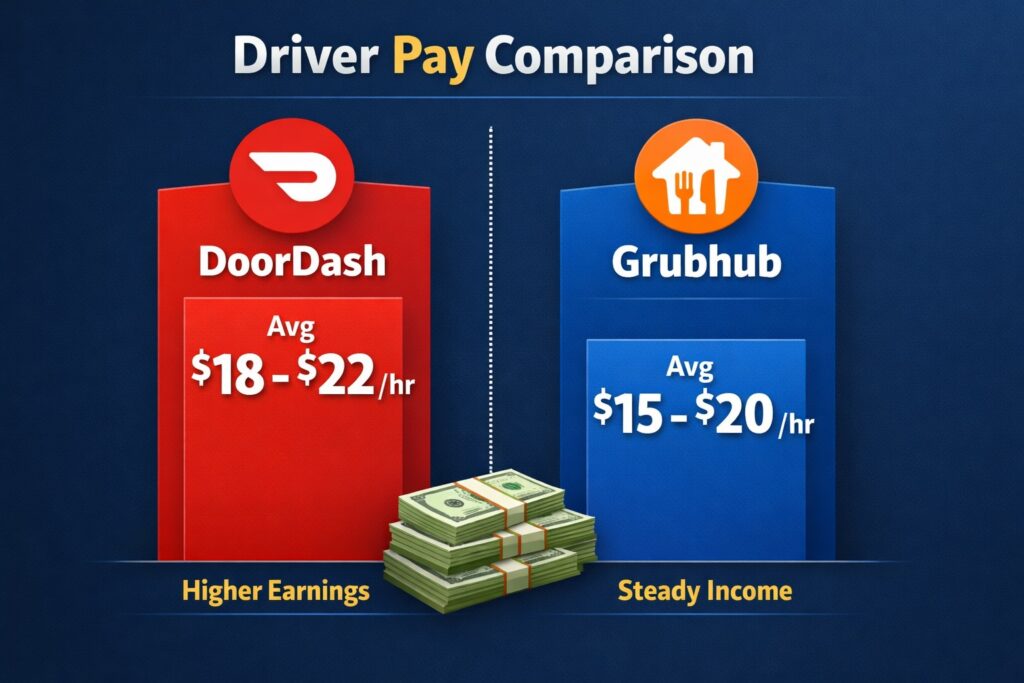
When comparing Grubhub vs DoorDash driver pay, it’s important to understand how both DoorDash and Grubhub structure their earnings models for delivery partners. While both platforms provide flexible gig-based income opportunities, their payout systems differ in terms of base pay, incentives, and order demand.
DoorDash calculates driver earnings using a combination of base pay, customer tips, and promotional bonuses such as Peak Pay during busy hours. The base pay generally ranges from $2 to $10 per order depending on delivery distance, estimated time, and order complexity. Due to higher order volumes in many U.S. cities, DoorDash drivers often receive more frequent delivery requests, which can lead to increased total hourly earnings.
In contrast, Grubhub also follows a similar earning structure that includes base pay, tips, and occasional bonuses. However, when analyzing Grubhub vs DoorDash driver pay, one key advantage of Grubhub is its guaranteed hourly minimum in certain regions for drivers who schedule delivery blocks in advance. This can provide a more stable income stream compared to purely on-demand delivery models.
Overall, in the Grubhub vs DoorDash driver pay comparison, DoorDash may offer higher earning potential due to greater demand and delivery frequency, while Grubhub can provide more predictable earnings in select markets through scheduled delivery opportunities and minimum pay guarantees.
Business Model Comparison
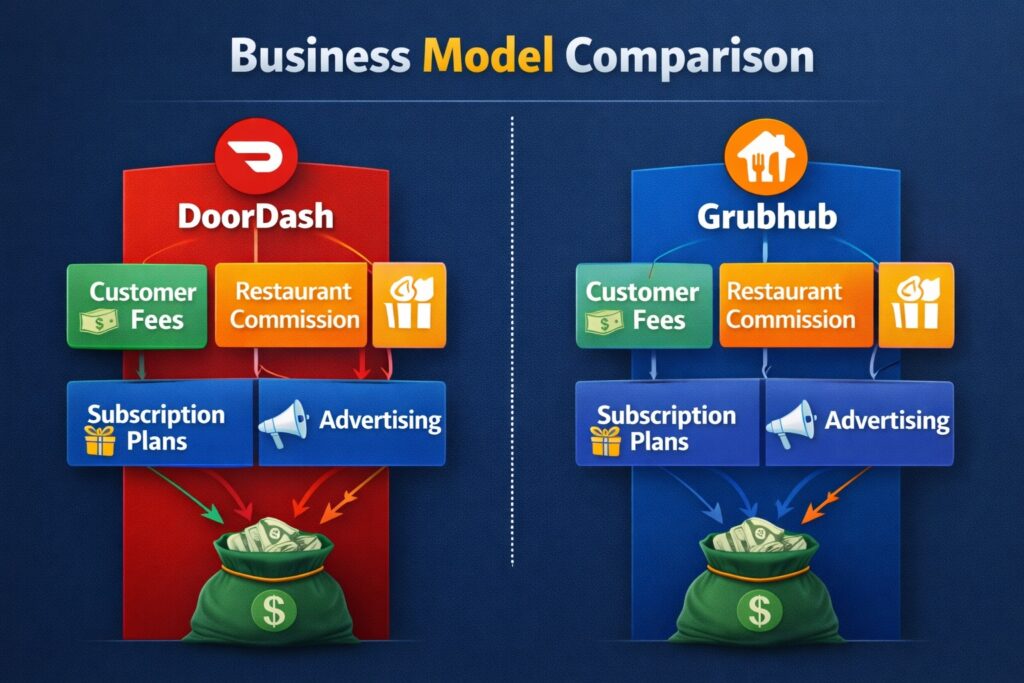
When comparing DoorDash and Grubhub in terms of fees, features, and earnings, it’s important to understand how each platform generates revenue. Their business models directly influence delivery charges, driver compensation, and the commission rates charged to restaurants, which is why costs and payouts can vary between the two services.
Here’s a deep-dive into the business models of DoorDash and Grubhub:
DoorDash Business Model
- Commission-Based Revenue
DoorDash charges restaurants a commission fee (typically between 15% to 30%) on every order placed through its platform. - Customer Delivery Fees
Customers pay delivery and service fees depending on order size, distance, and demand (peak hours may increase fees). - DashPass Subscription
A monthly subscription model where users pay a fixed fee to get free delivery and reduced service charges. - Promoted Listings for Restaurants
Restaurants can pay extra to appear at the top of search results, increasing visibility and order volume. - Logistics-as-a-Service (DoorDash Drive)
Offers delivery infrastructure to businesses that want delivery without listing on the marketplace. - Advertising Solutions
Restaurants can run sponsored ads within the app to target more customers locally.
Grubhub Business Model
- Restaurant Commission Fees
Grubhub earns revenue by charging partner restaurants commission rates typically ranging from 10% to 25%. - Delivery & Service Fees from Customers
Users pay delivery and service charges depending on the location and restaurant partner. - Grubhub+ Subscription
Premium membership offering unlimited free deliveries and exclusive restaurant deals. - Marketplace Listing Fees
Restaurants pay for enhanced visibility and featured placement inside the app. - White-Label Delivery Services
Grubhub provides backend delivery services to restaurants through its logistics network. - Corporate Meal Programs
Offers food delivery solutions for offices and corporate clients through enterprise partnerships.
Pros and Cons of DoorDash
Before deciding which platform is better in the DoorDash vs Grubhub comparison, it’s important to evaluate the strengths and limitations of DoorDash from the perspective of customers, drivers, and restaurant partners.
Pros of DoorDash
- Wider availability across thousands of U.S. cities
- Lower average delivery fees in many locations
- Higher order volume for delivery drivers
- DashPass subscription reduces delivery costs
- Faster delivery times due to strong logistics network
- Offers grocery and retail delivery services
Cons of DoorDash
- Service fees can increase during peak hours
- Driver earnings may fluctuate based on demand
- High commission fees for restaurant partners
- Limited guaranteed pay for delivery drivers
- Customer support response time may vary
Pros and Cons of Grubhub
To make a fair decision in the DoorDash vs Grubhub comparison, it’s equally important to understand the advantages and drawbacks of Grubhub for customers, drivers, and restaurant owners.
Pros of Grubhub
- Strong partnerships with local restaurants
- Grubhub+ offers free delivery on eligible orders
- Guaranteed hourly pay in select markets
- Advanced order scheduling for drivers
- Loyalty rewards and restaurant deals
- Corporate meal delivery programs
Cons of Grubhub
- Higher average delivery fees in some regions
- Lower order volume compared to competitors
- Slower delivery time in less populated areas
- Limited grocery or retail delivery options
- Driver incentives may vary by location
Which App is Better for Customers?
When evaluating the DoorDash vs Grubhub comparison from a customer’s perspective, both DoorDash and Grubhub offer convenient food ordering experiences, but the overall value may vary based on pricing, restaurant availability, and delivery speed.
DoorDash is often preferred by customers due to its wider coverage across cities and access to a larger network of restaurant partners. The platform’s DashPass subscription helps frequent users save on delivery fees and service charges, making it a cost-effective option for regular orders. Additionally, DoorDash provides faster delivery in many locations due to its high driver availability and advanced logistics system.
On the other hand, Grubhub may appeal to customers who are looking for exclusive restaurant deals, loyalty rewards, and scheduled delivery options. Its Grubhub+ membership offers benefits such as unlimited free delivery from eligible restaurants, which can be beneficial for users who consistently order from participating partners.
Overall, in the DoorDash vs Grubhub for customers comparison, DoorDash stands out for affordability and delivery speed, while Grubhub may offer better value through promotions and loyalty-based incentives depending on user preferences and location.
Which Platform is Better for Drivers?
| Driver Priority | Better Platform |
| Higher hourly average | DoorDash |
| More delivery requests | DoorDash |
| Bigger payouts per order | Grubhub |
| Flexible work schedule | DoorDash |
| Structured shift system | Grubhub |
| Potential tip advantage | Grubhub |
When it comes to choosing between DoorDash and Grubhub, drivers usually care about three things: earning potential, order availability, and flexibility. Based on the latest 2024–2026 industry data and driver reports, both platforms offer solid gig opportunities—but they perform very differently in real-world conditions.
1. Average Driver Earnings
- In 2026, U.S. delivery drivers earn $15–$30 per hour on average, depending on location and demand.
- DoorDash drivers typically earn around $18–$22/hour including tips based on 2024 industry earnings reports.
- Grubhub drivers generally earn $15–$20/hour, although top performers can make up to $25–$30/hour during peak hours in busy cities.
2. Order Volume & Consistency
- DoorDash usually offers more frequent delivery requests, helping drivers stay busy and reduce idle time.
- Grubhub tends to send fewer but higher-value orders, which may result in better per-delivery payouts but longer waiting periods.
3. Flexibility & Scheduling
- DoorDash allows drivers to “Dash Now” anytime without scheduling shifts in many locations.
- Grubhub often prefers drivers to book time blocks, which may limit on-demand flexibility but can provide more structured earnings.
4. Tips & Income Stability
Tips make up over 50% of restaurant delivery workers’ total income, meaning app design and tipping flow can directly affect driver pay.
Some reports suggest that platforms allowing pre-checkout tipping (like Grubhub) may lead to higher average gratuities compared to post-checkout tipping systems.
Future of Food Delivery Apps in 2026
The online food delivery industry is expected to grow rapidly in the coming years, with the global market projected to reach nearly $183 billion by 2025 and continue expanding significantly by 2030 due to increasing demand for convenience-based ordering and digital services. This growth is mainly driven by the rising use of mobile apps, AI-based delivery systems, and cloud kitchens that help restaurants operate without physical dine-in spaces.
In 2026, food delivery platforms will focus more on:
- AI-powered route optimization for faster deliveries
- Cloud kitchens to reduce operational costs
- Contactless payments and real-time tracking
- Subscription-based delivery models
- Expansion into grocery and retail delivery services
This is where partnering with a reliable Food Delivery App Development Company like Synarion IT Solutions becomes important for startups and businesses looking to build scalable and feature-rich delivery platforms. With the increasing demand for smart and automated delivery solutions, investing in advanced app development will be essential to stay competitive in the growing on-demand market.
Conclusion
While both DoorDash and Grubhub are trusted food delivery platforms, each service brings unique advantages to the table based on what customers, drivers, or restaurant partners are looking for in terms of convenience, pricing, and features.
DoorDash stands out with its wider market reach, lower delivery fees in many locations, and higher order volume for drivers, making it a better option for frequent customers and full-time delivery partners. On the other hand, Grubhub offers structured scheduling, loyalty rewards, and guaranteed hourly pay in select regions, which may appeal more to part-time drivers and users who prefer exclusive restaurant deals.
Ultimately, the better platform depends on whether you prioritize flexibility, affordability, or earning stability. Businesses and startups planning to enter the on-demand delivery space can also take inspiration from these platforms’ business models to build scalable and customer-friendly delivery apps.
FAQs
1. Which is cheaper: DoorDash or Grubhub?
In most cases, DoorDash is considered more affordable due to its lower base delivery fees and DashPass subscription, which offers reduced or zero delivery charges on eligible orders. However, Grubhub may provide better restaurant-specific discounts depending on the location.
2. Do DoorDash drivers earn more than Grubhub drivers?
Generally, DoorDash drivers tend to earn higher average hourly income because of greater order volume and consistent delivery demand. Grubhub drivers, however, may benefit from guaranteed hourly pay in select markets through scheduled delivery blocks.
3. Which food delivery app is better for customers?
DoorDash is often preferred for faster delivery times and wider restaurant availability, while Grubhub may be better for customers who want loyalty rewards and exclusive deals through its Grubhub+ membership.
4. How do DoorDash and Grubhub make money?
Both platforms earn revenue through restaurant commission fees, delivery charges, customer service fees, subscription plans, and promotional listings offered to restaurant partners.
5. Can I build an app like DoorDash or Grubhub?
Yes, startups and businesses can partner with a professional Food Delivery App Development Company like Synarion IT Solutions to create scalable and feature-rich food delivery apps with real-time tracking, payment integration, and driver management systems.




What do you think?
It is nice to know your opinion. Leave a comment.