











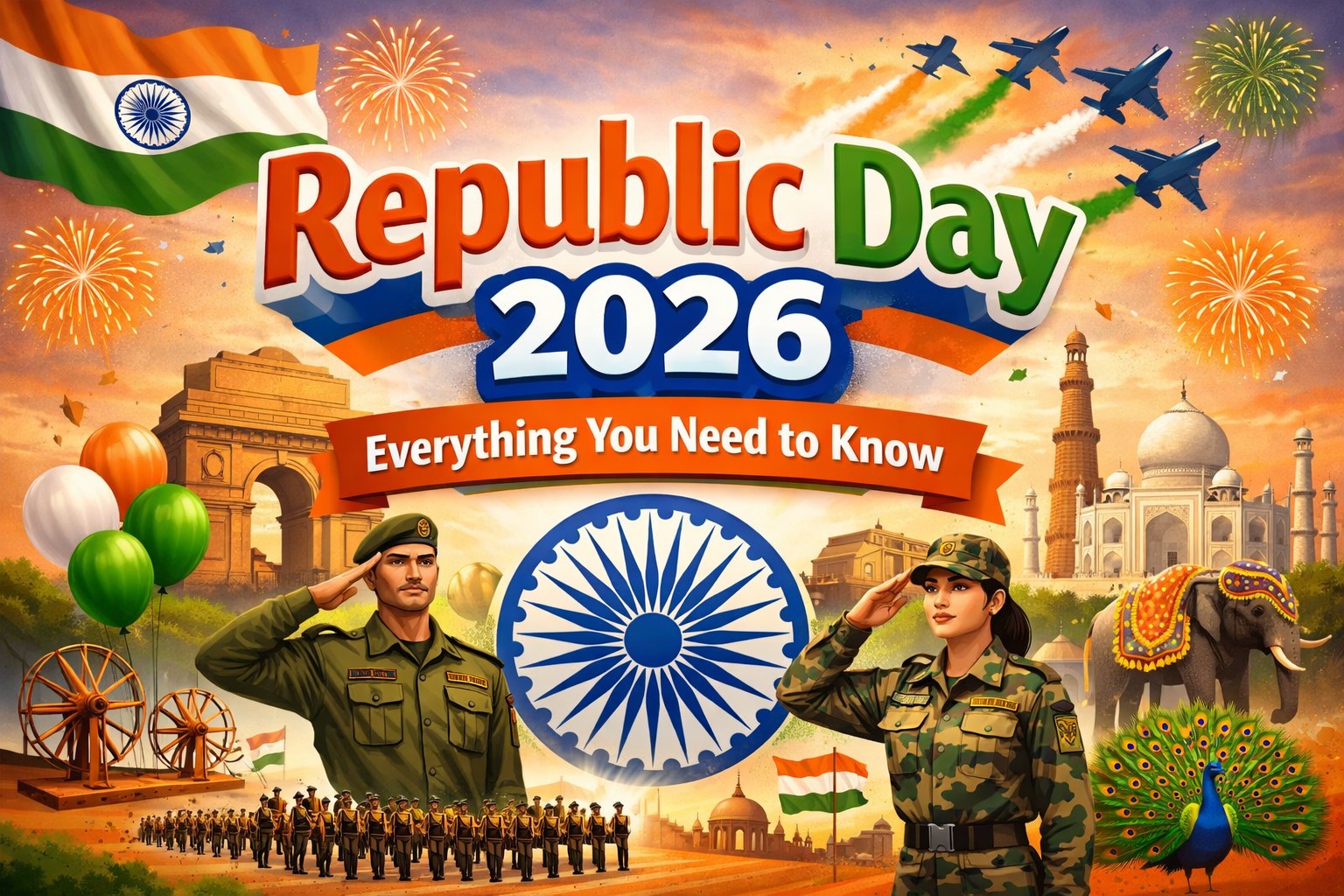



Every year on 26 January, India commemorates one of its most important national holidays — Republic Day 2026, locally known as Gantantra Diwas. This day marks the birth of the Indian Republic and celebrates the coming into effect of the Constitution of India in 1950, affirming India’s commitment to democracy, justice, liberty and equality. It is a day of pride, patriotism, and unity as citizens from all walks of life celebrate the democratic spirit of the world’s largest democracy.
In this comprehensive guide, we explore Republic Day 2026’s history, deeper significance, theme, chief guests, parade highlights and why this day continues to hold immense importance in the hearts of every Indian.
What Is Republic Day (Gantantra Diwas)?
Republic Day, celebrated on 26 January every year, is the day when the Constitution of India came into force in 1950, replacing the Government of India Act (1935) and transforming India into a sovereign democratic republic. The Constitution gave Indian citizens fundamental rights and established justice, liberty, equality, and fraternity as guiding principles.
This momentous event is also known as Gantantra Diwas in Hindi and several Indian languages — literally translating to “Republic Day”.
The choice of 26 January itself holds historic significance. It was on this date in 1930 that the Indian National Congress declared Purna Swaraj (complete independence) from British rule, making this date symbolic of India’s pursuit of self-rule long before independence in 1947.
Why We Celebrate Republic Day?
At the core of Republic Day 2026 lies more than just ceremonial tribute — the celebration represents the triumph of democracy and the rule of law in India. But why exactly do we celebrate Republic Day? The answer belongs to every citizen of India who cherishes the democratic values which shape the nation.
Celebration of the Constitution
The Constitution of India is the supreme law of the land. It enshrines the rights and responsibilities of every citizen and lays the foundation of a democratic society. Republic Day marks the day when this Constitution came into effect, empowering citizens and affirming that the people — not colonial powers — hold the ultimate authority.
Transformation to a Republic
India became a Republic on 26 January 1950 — meaning the head of state would be an elected representative and not a hereditary monarch or a representative of a foreign sovereign. This transition solidified India’s status as a sovereign, independent, and democratic nation.
Celebration of Democratic Values
Republic Day reminds citizens of the values of liberty, equality, justice, and fraternity — guiding principles enshrined in the Constitution. It encourages citizens to uphold these ideals and actively participate in democratic processes.
Unity in Diversity
Every year, Republic Day celebrations reflect India’s vast cultural diversity. Through parades, performances, and tableaux from different states and union territories, the event celebrates the idea of unity in diversity — a hallmark of Indian society.
Republic Day 2026: What’s Special This Year
Every Republic Day has its unique flavor, but Republic Day 2026 holds special significance for several reasons.
150th Anniversary of Vande Mataram
One of the most inspiring aspects of Republic Day 2026 is the celebration of the 150th anniversary of the patriotic song Vande Mataram, written by Bankim Chandra Chattopadhyay and first published in the late 19th century. This song became a rallying cry during India’s freedom struggle and continues to evoke deep patriotic emotion across generations.
The theme of this Republic Day’s parade and festivities is centered around this milestone, integrating the legacy of Vande Mataram into cultural presentations, decorations, and performances.
First Time with Two EU Chief Guests
For Republic Day 2026, India has invited two prominent leaders from the European Union — Ursula von der Leyen, President of the European Commission, and António Costa, President of the European Council, to attend as chief guests. This historic gesture reflects the importance of India-EU diplomatic and economic ties and marks the first time two top EU leaders will attend the parade together.
Their presence highlights India’s growing global influence and strengthens its strategic relationships on the international stage.
Inclusive Citizen Participation
Unlike previous years where the focus might have been primarily on military and cultural contingents, Republic Day 2026 encourages broader citizen participation. Thousands of individuals — including farmers, scientists, entrepreneurs, students, artisans, workers and volunteers — will be present as special guests at the parade, reflecting a more inclusive celebration.
Parade Highlights: Kartavya Path Spectacle
The Republic Day parade is the showpiece of Gantantra Diwas celebrations. Hosted on Kartavya Path in New Delhi, it showcases India’s cultural heritage, military might, and artistic achievements.
Here are some remarkable highlights expected for Republic Day 2026:
Military Pageantry
The parade features marching contingents of the Indian Army, Navy, and Air Force, demonstrating discipline, precision and strength. In 2026, for the first time, the Indian Army will introduce a Battle Array Formation — a dynamic representation of how forces respond in real battle scenarios.
Flypast and Air Displays
A thrilling highlight is the Indian Air Force flypast, which includes fighter jets, helicopters, and aerobatic performances. These aerial displays are a favorite part of the parade for spectators of all ages.
Cultural Performances
Artists from across the country perform traditional dances, music and cultural tableaux that represent India’s diversity. In 2026, cultural performances will align closely with the Vande Mataram theme, telling the story of India’s cultural and patriotic heritage.
Tableaux from States & Ministries
A total of around 30 tableaux from Indian states, union territories, ministries and departments will showcase themes of innovation, heritage, progress and self-reliance. These floats bring forward the stories of regional traditions, historical achievements and modern advancements.
Special Recognitions
In recent news taking Republic Day celebrations to new heights, individuals like Aesha Singh, recognized for her environmental work through the Namami Gange initiative, will be honored as special guests at the parade.
Similarly, Assistant Commandant Simran Bala of the Central Reserve Police Force (CRPF) is making history as the first woman to lead an all-male marching contingent in the Republic Day parade — signifying progress toward greater gender representation in India’s security forces.
Chief Guests: Diplomacy Meets Celebration
The tradition of inviting a foreign dignitary as chief guest at the Republic Day parade underscores India’s diplomatic engagement with the world. Over the decades, world leaders have graced the ceremony — from presidents and prime ministers to heads of international organizations.
Ursula von der Leyen
Ursula von der Leyen, as President of the European Commission, leads the executive arm of the European Union (EU), setting policy direction and overseeing its implementation. Her presence at Republic Day 2026 underscores the importance India places on a stronger partnership with the EU.
António Costa
António Costa, as President of the European Council, chairs meetings of EU member states and represents the Union’s interests on the global stage. Having both EU leaders attend together is unprecedented and marks a new chapter in India-EU relationships.
This diplomatic milestone at Republic Day 2026 reflects India’s rising strategic footprint and aligns with ongoing talks on economic collaboration and trade agreements.
Significance of Gantantra Diwas
Gantantra Diwas is more than a ceremonial day — it signifies the strength of a nation governed by law, shaped by its people’s aspirations, and guided by the principles of justice and liberty. Celebrating Republic Day annually reinforces:
- Respect for the Constitution and rule of law
- Recognition of citizen rights and duties
- Commitment to democratic governance
- Celebration of culture, tradition and diversity
- Strengthened global partnerships
Together, these elements make Republic Day a celebration of national identity, collective memory, and future aspiration.
Local Celebrations Across the Country
While the grand parade in New Delhi draws global attention, Republic Day celebrations unfold in every state and union territory. Governors and chief ministers host flag-hoisting ceremonies, cultural programs, and award presentations to honor citizens’ contributions. Extensive security, cultural showcases, and community events make Gantantra Diwas a day of pride nationwide.
How to Watch Republic Day 2026
For those unable to attend in person, Republic Day 2026 events will be broadcast across national TV and online platforms:
- Live broadcast on Doordarshan
- Online streaming on government portals like PIB and MyGov
- Social media channels of official government handles
Most broadcasters begin coverage early on 26 January, with the parade starting around 10:30 AM IST and concluding with the spectacular flypast and salute to the nation.
Final Thoughts
Republic Day 2026 (Gantantra Diwas) is not just a national holiday; it’s a reminder of India’s journey from colonial rule to a sovereign republic — a country shaped by its Constitution and sustained by its people’s democratic spirit. The day celebrates India’s strength, diversity, unity and relentless pursuit of progress and justice.
As India observes this special day on 26 January 2026, the celebrations honor past sacrifices, village-to-village cultural expressions, military excellence, and global friendships — all woven into one unforgettable national experience.
Happy Republic Day 2026! Jai Hind!
FAQs
What is Republic Day (Gantantra Diwas)?
Republic Day is a national holiday in India celebrated on 26 January each year to mark the day the Constitution of India came into effect in 1950, making India a sovereign republic.
Why is Republic Day celebrated on 26 January?
26 January was chosen because on that date in 1930, Indian leaders first declared the goal of Purna Swaraj (complete independence) from British rule. The Constitution was later enforced on this symbolic date in 1950.
What number Republic Day is 2026?
Republic Day 2026 marks India’s 77th Republic Day since the Constitution came into force in 1950.
What happens on Republic Day?
The main celebration includes a grand parade at Kartavya Path in New Delhi featuring military displays, cultural tableaux, marching contingents, and an air force flypast.
Who usually unfurls the flag on Republic Day?
The President of India unfurls the national flag during the Republic Day ceremony, followed by a 21-gun salute and public celebrations.
Is Republic Day the same as Independence Day?
No. Independence Day (15 August) celebrates freedom from British rule in 1947, while Republic Day (26 January) marks the day the Constitution was implemented and India became a republic.
What is the significance of the Constitution on Republic Day?
Republic Day highlights India’s democratic framework and celebrates the rights and duties of citizens as outlined in the Constitution.
How long are Republic Day celebrations?
While Republic Day itself is on 26 January, official events like the parade and Beating Retreat ceremony span several days of cultural and ceremonial programs.
Related Blog: Republic Day Wishes, Quotes and Messages




What do you think?
It is nice to know your opinion. Leave a comment.