











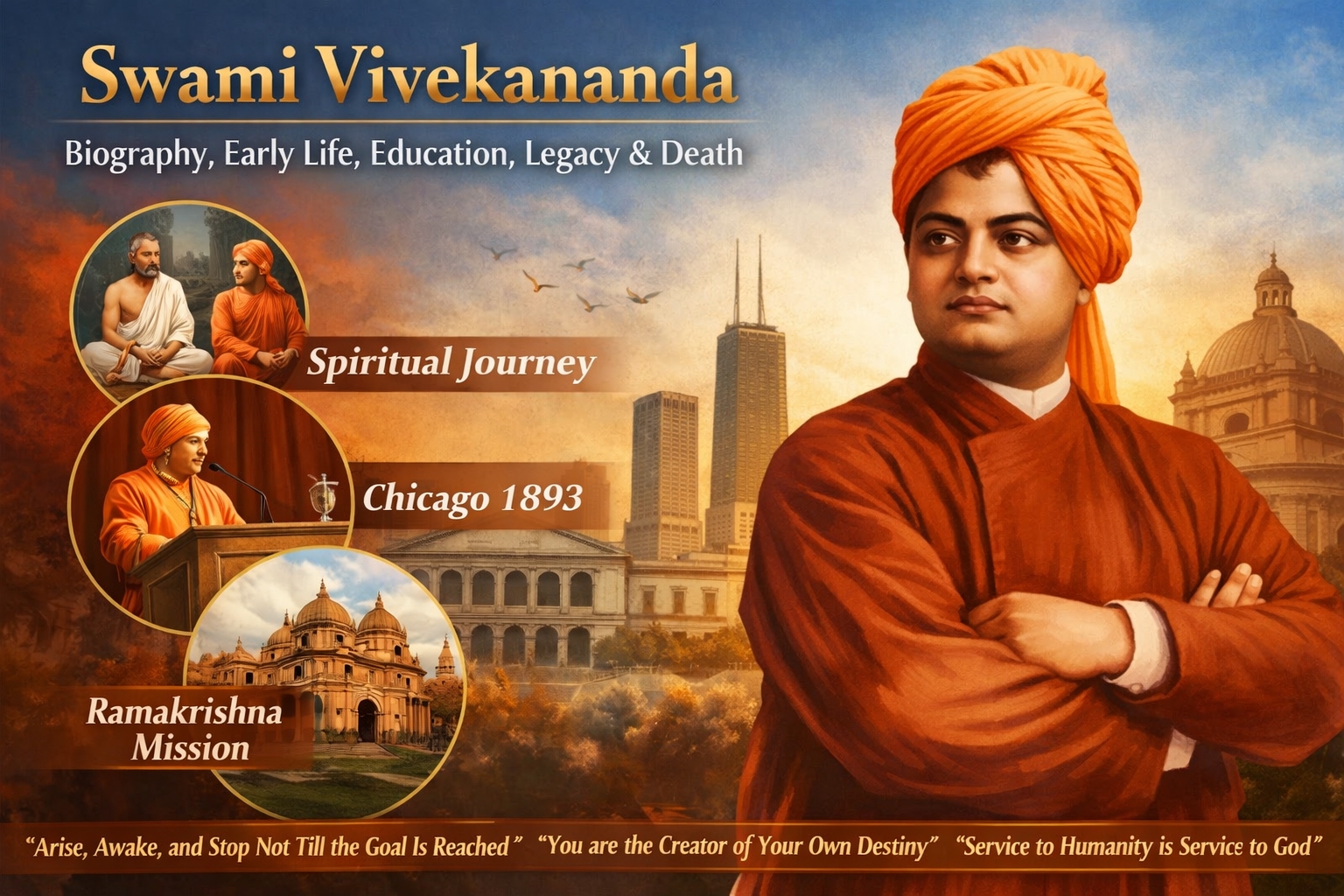



Swami Vivekananda remains one of the most influential spiritual leaders, philosophers, and reformers India has ever produced. His teachings continue to inspire millions across the globe, especially the youth, with messages of self-belief, discipline, patriotism, and spiritual awakening. Best known for introducing Indian philosophies of Vedanta and Yoga to the Western world, Swami Vivekananda’s life was a perfect blend of spirituality, intellect, and fearless leadership.
This comprehensive biography explores Swami Vivekananda’s early life, education, spiritual journey, global influence, legacy, and death, offering a deep understanding of the man who ignited the spirit of modern India.
Who Was Swami Vivekananda?
Swami Vivekananda was a Hindu monk, philosopher, author, and social reformer who played a pivotal role in the revival of Hinduism in India and its global recognition. He was the chief disciple of Sri Ramakrishna Paramahamsa and the founder of the Ramakrishna Mission.
He believed that service to humanity is service to God and emphasized the upliftment of the poor, education for all, and spiritual empowerment of youth. His speeches, writings, and Swami Vivekananda quotes continue to motivate people to discover their inner strength and purpose.
Early Life of Swami Vivekananda
Birth and Family Background
Swami Vivekananda was born as Narendranath Datta on 12 January 1863 in Kolkata (then Calcutta), Bengal Presidency, British India. His birth anniversary is celebrated as National Youth Day in India, highlighting his immense influence on young minds.
He was born into a well-educated and culturally rich Bengali family:
- Father: Vishwanath Datta – a successful attorney at the Calcutta High Court
- Mother: Bhuvaneshwari Devi – a deeply spiritual and compassionate woman
His mother’s strong character and spiritual inclination played a crucial role in shaping his personality.
Childhood Traits and Personality
From a very young age, Narendranath showed exceptional intelligence, curiosity, and leadership qualities. He was energetic, courageous, and deeply inquisitive about life and spirituality. Unlike other children, he often questioned religious practices and was eager to know the truth behind rituals.
Some defining traits of his childhood included:
- Sharp memory and logical thinking
- Interest in music, literature, and philosophy
- Compassion for the poor and suffering
- Fearlessness and moral strength
He was also physically active, participating in wrestling, gymnastics, and outdoor games, which later influenced his emphasis on physical strength along with spiritual growth.
Education of Swami Vivekananda
Schooling and Academic Excellence
Swami Vivekananda received his early education at Ishwar Chandra Vidyasagar’s Metropolitan Institution, where he excelled in academics. He was known for his remarkable ability to grasp complex subjects quickly.
Later, he enrolled at:
- Presidency College, Kolkata
- Scottish Church College
At Scottish Church College, he studied a wide range of subjects, including:
- Western philosophy
- Logic and ethics
- History
- Literature
- Sanskrit scriptures
Influence of Western Philosophy
During his college years, Narendranath studied thinkers such as Kant, Hegel, John Stuart Mill, Herbert Spencer, and Darwin. While he admired Western rationalism and scientific thought, he felt a spiritual void that intellectual knowledge alone could not fill.
This internal conflict led him to question:
“Have you seen God?”
This question became the turning point in his spiritual journey.
Meeting Sri Ramakrishna Paramahamsa
The Spiritual Turning Point
In 1881, Narendranath met Sri Ramakrishna Paramahamsa, a mystic saint of Dakshineswar Kali Temple. This meeting transformed his life forever.
When Narendranath asked Ramakrishna whether he had seen God, Ramakrishna replied:
“Yes, I see Him as clearly as I see you, only in a much more intense sense.”
This answer deeply impacted Narendranath, as it provided the direct spiritual experience he had been seeking.
Disciple of Ramakrishna
Over time, Narendranath became Ramakrishna’s closest disciple. Despite initial doubts, he gradually accepted Ramakrishna as his spiritual guide. Under his mentorship, he learned:
- The essence of Vedanta
- Unity of all religions
- Importance of self-realization
- Love and service to humanity
Before his death in 1886, Ramakrishna entrusted Narendranath with the responsibility of guiding his disciples and spreading his teachings.
Becoming Swami Vivekananda
After Ramakrishna’s death, Narendranath renounced worldly life and took monastic vows. He adopted the name Swami Vivekananda, meaning the bliss of discerning wisdom.
Years of Wandering Monk
Swami Vivekananda spent several years traveling across India as a wandering monk (Parivrajaka). During this time, he:
- Witnessed widespread poverty and social inequality
- Observed the suffering of common people
- Realized the need for national awakening
These experiences strengthened his resolve to work for India’s spiritual and social regeneration.
Swami Vivekananda at the Parliament of Religions (1893)
Historic Chicago Speech
In 1893, Swami Vivekananda represented India at the World’s Parliament of Religions in Chicago, USA. His opening words:
“Sisters and Brothers of America”
received a standing ovation and instantly made him a global figure.
Global Impact
In his speeches, he emphasized:
- Universal brotherhood
- Religious tolerance
- Harmony among faiths
- Spiritual unity of mankind
He presented Hinduism as a rational, inclusive, and scientific religion, earning immense respect worldwide.
Teachings and Philosophy of Swami Vivekananda
Core Philosophical Beliefs
Swami Vivekananda’s philosophy was rooted in Advaita Vedanta, combined with practical spirituality. His core teachings include:
- Self-belief: “You are the creator of your own destiny.”
- Strength: Physical, mental, and spiritual strength are essential.
- Service: Serving humanity is the highest form of worship.
- Education: True education builds character and confidence.
- Youth empowerment: Youth are the backbone of the nation.
His powerful Swami Vivekananda quotes continue to inspire leaders, students, and entrepreneurs.
Social Reforms and Contributions
Education for All
Swami Vivekananda believed education was the key to national progress. He advocated:
- Education for women
- Upliftment of the poor
- Value-based learning
Ramakrishna Mission
In 1897, he founded the Ramakrishna Mission to combine spiritual teachings with social service. The mission focuses on:
- Education
- Healthcare
- Disaster relief
- Rural development
The mission continues to serve millions across India and abroad.
Literary Works of Swami Vivekananda
Swami Vivekananda was also a prolific writer and thinker. Some of his notable works include:
- Raja Yoga
- Karma Yoga
- Bhakti Yoga
- Jnana Yoga
- Lectures from Colombo to Almora
These works present complex spiritual ideas in simple, practical language.
Legacy of Swami Vivekananda
Impact on India
Swami Vivekananda played a crucial role in:
- Inspiring India’s freedom movement
- Reviving Indian spiritual pride
- Empowering youth with confidence
Leaders like Mahatma Gandhi, Subhas Chandra Bose, and Jawaharlal Nehru were deeply influenced by his teachings.
Global Recognition
Today, Swami Vivekananda is regarded as:
- A global spiritual ambassador of India
- A pioneer of interfaith harmony
- A youth icon and philosopher
His statues, institutions, and teachings are found worldwide.
Death of Swami Vivekananda
Swami Vivekananda attained Mahasamadhi on 4 July 1902 at the age of just 39 years, at Belur Math near Kolkata.
Though his life was short, his impact was profound and eternal. It is believed that he had predicted he would not live beyond 40 years.
Why Swami Vivekananda Is Still Relevant Today?
In today’s fast-paced, stressful world, Swami Vivekananda’s teachings provide:
- Mental strength and clarity
- Purpose-driven living
- Moral and ethical guidance
- Motivation for youth
His message of “Arise, Awake, and Stop Not Till the Goal Is Reached” continues to guide generations.
National Youth Day
In honor of his birth anniversary, 12 January is celebrated as National Youth Day in India, recognizing his immense contribution to youth inspiration and nation-building.
Conclusion
The biography of Swami Vivekananda is not just the story of a monk but the journey of a visionary who reshaped India’s spiritual identity and inspired the world. From his early life as Narendranath Datta to becoming a global spiritual leader, his life stands as a symbol of courage, wisdom, and selfless service.
Even today, Swami Vivekananda’s life, teachings, and legacy remain a guiding light for anyone seeking purpose, strength, and inner awakening.
FAQs
Who was Swami Vivekananda?
Swami Vivekananda was a renowned Indian Hindu monk, philosopher, and social reformer. He was the chief disciple of Sri Ramakrishna Paramahamsa and played a major role in introducing Indian philosophies such as Vedanta and Yoga to the Western world.
What was Swami Vivekananda’s original name?
Swami Vivekananda was born as Narendranath Datta on 12 January 1863 in Kolkata, India. He adopted the name Swami Vivekananda after embracing the monastic life.
Why is Swami Vivekananda famous worldwide?
He gained global recognition after his historic speech at the World’s Parliament of Religions in Chicago in 1893, where he spoke about universal brotherhood, religious harmony, and tolerance, beginning with the famous words, “Sisters and Brothers of America.”
What were the main teachings of Swami Vivekananda?
Swami Vivekananda taught self-belief, strength of character, service to humanity, unity of all religions, and the importance of education. He believed that serving people is the highest form of worship.
What is the Ramakrishna Mission?
The Ramakrishna Mission, founded by Swami Vivekananda in 1897, is a spiritual and humanitarian organization dedicated to education, healthcare, disaster relief, and social service, based on the teachings of Sri Ramakrishna.
When and how did Swami Vivekananda die?
Swami Vivekananda passed away on 4 July 1902 at Belur Math, Kolkata, at the age of 39. He attained Mahasamadhi, leaving behind a timeless spiritual and philosophical legacy.
Why is National Youth Day celebrated on Swami Vivekananda’s birthday?
National Youth Day is celebrated on 12 January, Swami Vivekananda’s birth anniversary, to honor his inspirational teachings and immense influence on youth empowerment, leadership, and nation-building.
What is the relevance of Swami Vivekananda in modern times?
Swami Vivekananda’s teachings remain highly relevant today as they inspire confidence, discipline, ethical living, and spiritual strength, especially among youth facing modern challenges.
Related Blog: Swami Vivekananda Quotes




What do you think?
It is nice to know your opinion. Leave a comment.