









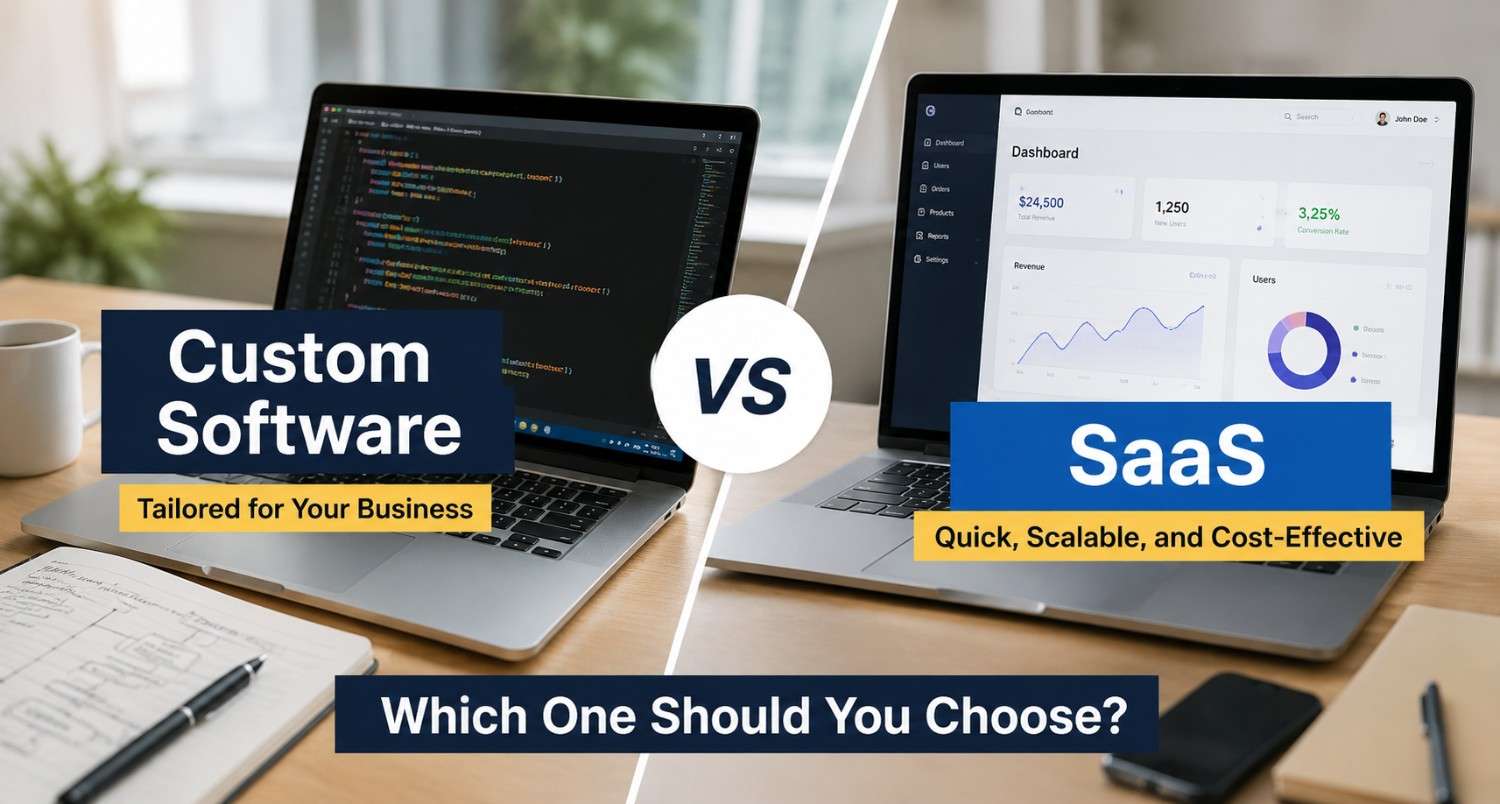



Every business eventually arrives at this crossroads: do you buy a ready-made SaaS tool or invest in building custom software tailored to your exact needs?
It sounds like a simple question. But for most decision-makers — founders, CTOs, and operations heads — it is one of the highest-stakes technology decisions they will face. Get it wrong and you either overpay for software that fits like a rented suit, or sink six figures into a custom build that collapses under scope creep.
The good news? The answer is not a coin flip. It is a strategic call backed by data, use cases, and a clear understanding of your business trajectory. This article breaks it all down.
What Is Custom Software Development?
Custom software is built from scratch (or from a modular foundation) to serve the precise workflows, data structures, and integration needs of one specific organisation. Unlike off-the-shelf products, every feature is defined by the business — not the vendor.
Examples include a logistics company building its own route optimisation engine, a hospital deploying a proprietary patient management system, or an ecommerce brand creating a custom warehouse and order fulfilment dashboard that talks directly to its ERP.
At Synarion IT Solutions, custom software development is one of the core services delivered to startups, SMEs, and enterprise clients across healthcare, fintech, logistics, and retail verticals.
What Is SaaS?
Software as a Service (SaaS) is cloud-hosted software offered on a subscription basis. You pay monthly or annually, log in through a browser or app, and use a pre-built product shared by thousands of other businesses. Think Salesforce, Zoho, Shopify, Slack, or QuickBooks.
The global SaaS market was valued at $315.68 billion in 2025 and is projected to grow at a CAGR of 18.7% through 2034, potentially reaching $1,482 billion — reflecting how deeply subscription software has penetrated business operations worldwide.
SaaS platforms are fast to deploy, require no infrastructure management, and often include automatic updates and built-in security compliance. For businesses at early stages or with standard operational needs, they offer an excellent starting point.
The Core Differences: A Side-by-Side View
| Factor | Custom Software | SaaS |
|---|---|---|
| Time to deploy | 3 – 12 months | Days to weeks |
| Upfront cost | High ($50K – $500K+) | Low (subscription-based) |
| Ongoing cost | Lower over time | Recurring forever |
| Customisation | 100% tailored | Limited to vendor’s settings |
| Ownership | You own the IP | Vendor owns the product |
| Scalability | Built to your architecture | Dependent on vendor’s infrastructure |
| Integration | Deep, native integration | Via APIs (sometimes limited) |
| Data control | Full control | Stored on vendor’s servers |
| Security compliance | Configurable to your standards | Vendor-managed, shared environment |
When SaaS Wins
SaaS is not always the compromise option. In many scenarios, it is clearly the smarter choice.
1. You Need to Move Fast
If you are an early-stage startup validating a product idea, or a business that needs a CRM, marketing automation, or project management tool operational within the week — SaaS is unbeatable. Tools like HubSpot, Notion, or Jira can be up and running in hours. There is no development timeline, no discovery phase, and no QA cycle.
2. Your Needs Are Standard
SaaS thrives when your business process mirrors what thousands of other companies do. If you need to send email campaigns, track sales leads, manage HR records, or process payroll — you are solving a problem that SaaS vendors have already solved, tested at scale, and refined over years.
3. Your Budget Is Limited Right Now
The average custom software project in the US costs around $250,000, while SaaS subscriptions can start at under $100/month for small teams. For bootstrapped businesses or those in early growth stages, SaaS provides access to powerful tooling without a capital-intensive commitment.
4. You Want Zero Infrastructure Management
With SaaS, the vendor handles hosting, updates, security patches, and uptime. Your team focuses entirely on using the tool, not managing it. This is a significant operational advantage for non-technical teams and lean IT departments.
When Custom Software Win
The tide shifts decisively once your business has unique processes, complex integrations, or ambitions that outgrow what SaaS vendors offer.
1. Your Business Has Unique Workflows
If your core operations involve processes that no SaaS tool was designed for — a multi-step manufacturing quality check, a custom lending decision engine, a real-time multi-vendor inventory system — SaaS tools will either not fit at all, or you will spend enormous time and money trying to bend them into shape.
Custom software delivers exact-fit functionality. No workarounds, no wasted features, no “that’s just how the platform works” frustrations.
2. Total Cost of Ownership Favours Custom Over Time
Here is the financial reality most SaaS vendors do not advertise: subscription costs compound. A team of 50 paying $200/user/month on a SaaS platform spends $120,000 per year — every year. Over five years, that is $600,000 before accounting for price increases, which SaaS vendors have been known to implement aggressively.
A well-scoped custom software project — say $150,000–$250,000 upfront — often becomes cheaper in total cost of ownership within 3 to 5 years, especially when the platform scales with users at no incremental licensing cost.
3. Data Ownership and Security Matter to You
In heavily regulated industries — healthcare, BFSI (banking, financial services, insurance), legal, and government — data sovereignty is non-negotiable. Custom software means your data stays on your infrastructure, compliant with HIPAA, GDPR, RBI guidelines, or any sector-specific standard you operate under. <br>
Did you know? The BFSI sector dominated the custom software market in 2024, accounting for 28% market share at $22.1 billion — precisely because financial institutions cannot afford to store sensitive client data on shared SaaS environments.
4. Competitive Differentiation Is Your Priority
If your software IS your product — or if your internal operational system is a core competitive advantage — handing that to a SaaS vendor means every competitor can access the same capabilities at the same price. Custom software makes your processes proprietary.
Amazon did not build its logistics infrastructure on off-the-shelf SaaS. Neither did Netflix build its recommendation engine on a shared platform. At a smaller scale, the same principle applies: operational IP is business value.
5. Deep Integrations Are Non-Negotiable
Most growing businesses run on a stack — ERP, CRM, accounting, inventory, analytics. SaaS tools connect via APIs, but often with limitations: rate throttling, missing fields, vendor-controlled data schemas, or expensive middleware solutions like Zapier or MuleSoft.
Custom software is architected around your existing stack from day one. The integrations are native, not bolted on.
The Hybrid Approach: The Best of Both Worlds
Many mature businesses are now adopting a hybrid model — using SaaS for non-core, commodity functions (email, HR, payroll) while investing in custom-built solutions for the workflows that drive competitive differentiation.
For example, a retail brand may use Shopify for its storefront (SaaS), Klaviyo for email marketing (SaaS), but build a custom inventory and fulfilment engine to handle multi-warehouse, multi-channel logistics that no SaaS tool supports at the required level of complexity.
At Synarion IT Solutions, this hybrid model is increasingly what enterprise and mid-market clients request — leveraging SaaS where it works and building custom where it matters.
Real-World Industry Use Cases
Healthcare
Standard appointment booking might run on a SaaS solution like Calendly or Zocdoc. But a hospital network managing multi-department patient journeys, clinical workflows, and insurance integrations will invest in custom software development to ensure compliance and seamless care coordination.
Ecommerce
Most ecommerce businesses start on Shopify or WooCommerce — both excellent SaaS choices. As they scale into omnichannel, wholesale, and D2C with complex pricing rules, custom platforms or headless ecommerce development become necessary to maintain performance and flexibility.
Fintech
Lending platforms, trading dashboards, and digital wallets cannot operate on shared SaaS infrastructure due to regulatory mandates and the sheer complexity of financial calculations. Custom development is the norm for fintech products — and Synarion has deep expertise in this space.
Logistics and Supply Chain
Route optimisation, real-time driver tracking, multi-vendor order management — these are problem domains where SaaS tools rarely go deep enough. Custom mobile app development and web platform builds are standard investment for logistics companies seeking operational efficiency.
The Market Data Speaks Clearly
The data supports the growing investment in custom software as a long-term strategy:
- The global custom software development market was valued at $44.2 billion in 2025 and is projected to reach $213.4 billion by 2035 at a CAGR of 17.3%.
- Cloud-based custom development dominates with 67% market share in 2025, showing that custom does not mean legacy — modern custom software is cloud-native by default.
- SME adoption of custom software rose to 42% in recent years, driven by falling development costs, offshore partnerships, and AI-assisted development.
- In Asia Pacific — including India — the custom software market is growing at the highest CAGR globally, fuelled by digital transformation mandates and a deep pool of engineering talent.
These numbers tell a clear story: custom software is no longer just an enterprise luxury. It is an increasingly accessible and strategically essential investment for businesses across all sizes and sectors.
How to Make the Decision for Your Business
Use this decision framework to guide your choice:
Choose SaaS if:
- You need the tool live within weeks, not months
- Your process is standard and shared by thousands of businesses in your industry
- You are in early-stage validation and cannot commit capital to development
- The function is non-core (HR, payroll, basic CRM)
- Your team lacks the capacity to manage a development project
Choose Custom Software if:
- Your workflows are unique and SaaS tools require major workarounds
- You operate in a regulated industry with strict data residency requirements
- You plan to scale to thousands of users and recurring SaaS costs become significant
- Your software is a core part of your product or competitive advantage
- You need deep, reliable integrations with your existing tech stack
Choose Hybrid if:
- You run complex operations but also need commodity tools for standard functions
- You want to pilot a custom module alongside existing SaaS infrastructure before committing fully
- You are migrating off a SaaS platform gradually as your custom build matures
Why the Right Development Partner Changes Everything
The decision between custom and SaaS is only half the equation. If you choose custom, the quality of execution determines whether the investment pays off.
The global custom software development market was estimated at $43.16 billion in 2024 and is projected to reach $146.18 billion by 2030 at a CAGR of 22.6% — but alongside this growth, failed projects remain a real risk. Poor requirements, weak project governance, and inexperienced teams are the leading causes of cost overruns and delivery failures.
Synarion IT Solutions brings 7+ years of experience, a team of 50+ engineers, and 500+ delivered projects to every engagement. Whether you are scoping a greenfield custom build, migrating from a SaaS platform that has outgrown your needs, or building a hybrid architecture — the Synarion team brings technical depth and business alignment to every stage.
Explore Synarion’s services:
- Custom Software Development
- Mobile App Development
- Ecommerce Development
- SaaS Development
- IT Consulting Services
Final Verdict
There is no universally correct answer. SaaS wins on speed, accessibility, and ease. Custom software wins on ownership, differentiation, and long-term economics. The hybrid approach wins for complex, scaling businesses that need both.
What matters most is that the decision is made deliberately — based on your business model, growth roadmap, data requirements, and total cost of ownership — not on what is fastest to implement today or what a competitor is using.
If you are unsure which path fits your business, talk to the Synarion team. A free consultation with engineers who have built both SaaS platforms and custom enterprise software is the fastest way to get clarity before committing budget.




What do you think?
It is nice to know your opinion. Leave a comment.