











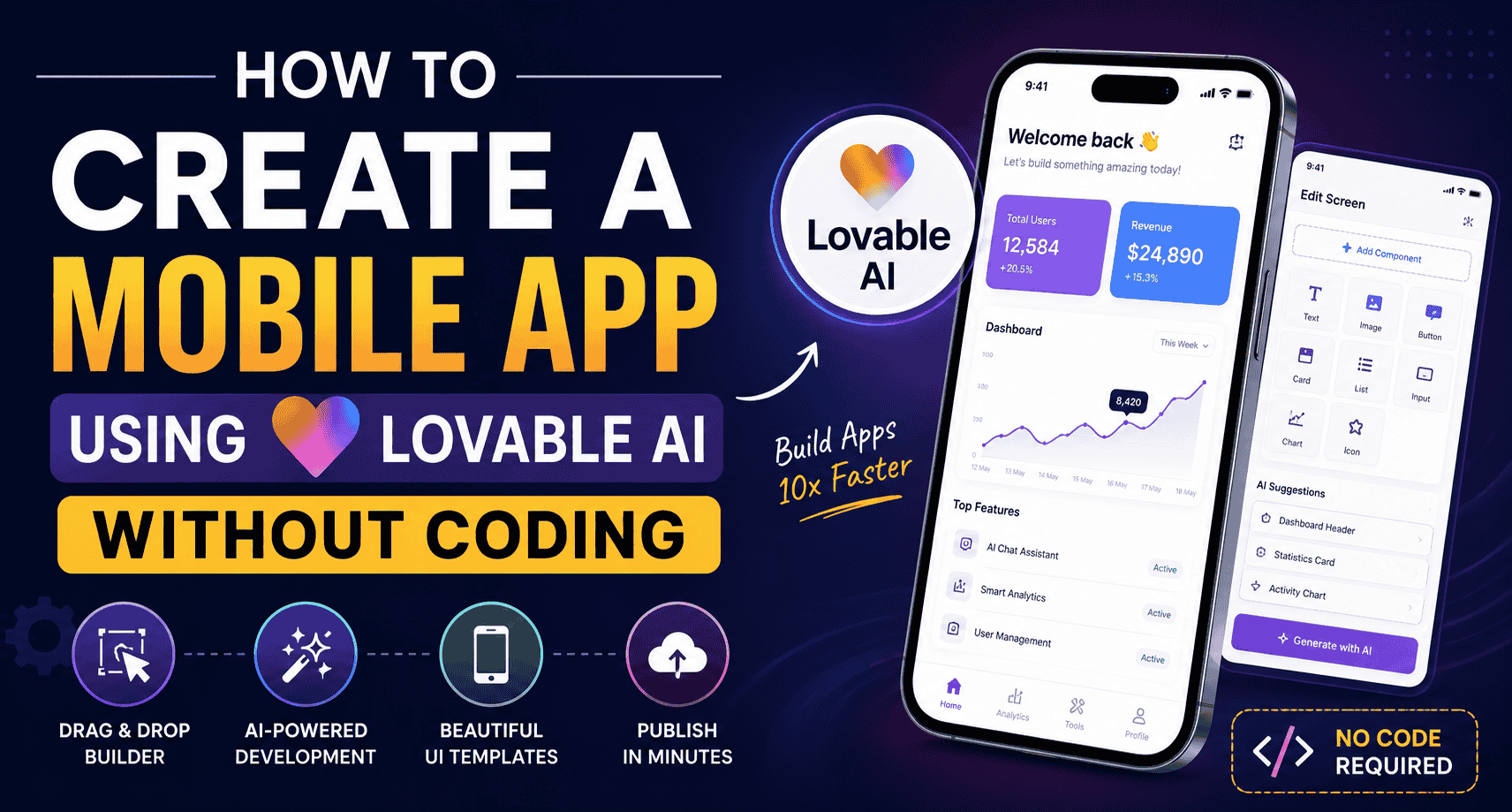



I still remember the days when building a mobile app meant months of planning, thousands of dollars in development costs, and a team of engineers working around the clock. That was the reality not too long ago. But things have changed — dramatically. When I first tried Lovable AI, I honestly did not expect much. Another AI tool making big promises, I thought. Within two hours, I had a working app prototype that would have taken my team two weeks to build from scratch.
If you are a founder, a product manager, or someone sitting on a brilliant app idea but held back by the technical complexity or budget constraints — this guide is written specifically for you. We are going to walk through exactly how to build a mobile application using Lovable AI, step by step, in plain English. No jargon. No fluff. Just the real process that works.
“Within two hours, I had a working app prototype that would have taken my team two weeks to build from scratch.”
At Synarion IT Solutions, we have helped hundreds of businesses bring their digital products to life. We have watched the development landscape shift with every new tool and technology. Lovable AI represents something genuinely different — not just an incremental improvement, but a fundamental change in how non-technical founders can bring their ideas to market.
What Is Lovable AI — And Why Should You Care?
Lovable AI (lovable.dev) is an AI-powered application builder that lets you create full-stack web and mobile applications by describing what you want in plain language. Think of it as having a senior developer sitting next to you at all times, one who never gets tired, never charges overtime, and builds exactly what you describe.
But here is what makes Lovable different from other no-code or AI tools you may have tried before. It does not just give you a drag-and-drop interface with pre-built templates. It actually writes real code — React on the frontend, with Supabase integration for the backend — code that you own, can export, and can hand to a developer to extend later.
For businesses exploring modern app development, resources like
Synarion IT Solutions’ mobile app development services
offer a great starting point to understand what is possible before you even open an AI tool.
Who Is Lovable AI Built For?
- First-time founders validating an app idea before investing in full development
- Small businesses that need a customer-facing app but cannot afford a six-figure build
- Product managers who want to create high-fidelity prototypes for stakeholder presentations
- Marketers and solopreneurs launching SaaS products or internal tools
- Developers who want to accelerate their workflow significantly
Setting Up Your Lovable AI Account
Getting started with Lovable is refreshingly simple. Here is how to go from zero to your first project in under ten minutes.
Step 1 — Create Your Account
Head over to lovable.dev and sign up with your Google account or email. The free plan gives you enough credits to explore the platform seriously. If you are planning to build something beyond a prototype, the paid plan starts at a very accessible price point and removes most of the limitations you will hit on free.
Pro tip Connect your GitHub account during setup: Lovable can automatically push your code to a GitHub repository, giving you a proper version history and the ability to collaborate with developers if you choose to bring a technical partner in later.
Step 2 — Understand the Credit System
Lovable works on a credit-based system. Each prompt you send uses credits, and more complex builds naturally consume more. Before you dive in, take fifteen minutes to read through their documentation — understanding how prompting works will save you significant credits and frustration down the road.
For a deeper dive into how AI is reshaping the economics of app development, our piece on
the hidden costs of building a mobile app
is worth reading before you commit to any build approach.
Planning Your App Before You Touch Lovable
This is the step most people skip — and it is the single biggest reason AI-built apps feel aimless and incomplete. The quality of what Lovable builds for you is directly proportional to the clarity of what you ask it to build.
Spend at least an hour answering these questions on paper before you open Lovable:
The Four Questions That Shape Everything
- What specific problem does your app solve? — Be ruthlessly specific. ‘A fitness app’ is not an answer. ‘An app that helps remote workers build a 10-minute morning movement habit through guided micro-workouts’ is an answer.
- Who is the primary user? — Describe one real person. Age, job, daily routine, and the exact moment they would reach for your app.
- What are the three core features? — Just three. Not ten. The minimum feature set that solves the core problem without anything extra.
- What does success look like after six months? — Number of users, revenue, engagement rate. A concrete goal keeps your build focused.
Synarion Insight Document your answers: Turn your answers into a one-page ‘app brief’ document. This becomes your north star when Lovable starts offering you suggestions and additions. It also becomes useful if you later work with a development team like ours to extend the app.
Building Your App Step by Step in Lovable
Now we get into the actual build. I am going to walk you through this using a real example — a simple client booking app for a wellness studio — so you can follow along with a concrete mental model rather than abstract instructions.
Step 3 — Write Your First Prompt the Right Way
Your first prompt to Lovable is the most important. It sets the entire foundation of your app. Most people write something like ‘build me a booking app.’ That will produce something generic and underwhelming.
Here is how to write a first prompt that actually works:
Weak prompt: “Build me a booking app for my wellness studio.”
Strong prompt: “Build a mobile-friendly booking app for a yoga studio. Users should be able to view available class slots for the current week, book a spot in a class, and receive a confirmation message. The studio owner needs a simple admin view to see all bookings by date. Use a calm, minimal design with lots of white space, soft blues and greens. No payment processing needed in this version.”
Notice what the strong prompt includes: the type of user, the core actions, the admin requirement, the visual direction, and what NOT to include. That last part — telling Lovable what to leave out — is something most beginners miss entirely.
Step 4 — Review the Initial Build
Lovable will generate your first version within a minute or two. Resist the urge to immediately prompt for changes. Instead, spend ten minutes actually clicking through what it built. Open it on your phone browser. Use it as a real user would.
Make a list of what works and what does not. Group your feedback into three categories before writing your next prompt:
- Functionality issues — things that do not work correctly
- Design issues — things that look wrong or feel off
- Missing features — things you specified that did not appear
Step 5 — Iterate With Focused Prompts
This is where most people go wrong. They write long prompts that ask for ten changes at once. Lovable handles focused, single-topic prompts far better than multi-change instructions. Instead of writing one enormous follow-up prompt, send three or four smaller ones in sequence.
Best practice One change per prompt: Make the booking confirmation message appear as a popup modal rather than a separate page. Then send the next prompt once that change is complete and verified.
Step 6 — Connect Your Backend With Supabase
For an app that needs to actually store data — bookings, user accounts, any kind of persistent information — you will need to connect Lovable to Supabase. The good news is that Lovable has a native Supabase integration that makes this surprisingly painless.
- Create a free Supabase account at supabase.com
- Create a new project and copy your project URL and API key
- In Lovable, click the Supabase integration button and paste your credentials
- Ask Lovable to set up the database tables you need — it will write the SQL and create them automatically
- Verify the connection is working by doing a test booking in your app and checking that it appears in your Supabase dashboard
For businesses that need enterprise-grade backend architecture, this is also where working with an experienced development partner becomes valuable.
Step 7 — Test Thoroughly Before Sharing
Before you show your app to anyone — investors, customers, or your team — put it through a proper testing pass. Here is a simple checklist we recommend to everyone who comes to us after building with Lovable:
- Test every user flow from start to finish on both iOS Safari and Android Chrome
- Test with a slow network connection (turn on throttling in your browser developer tools)
- Test with both correct and incorrect inputs — what happens when a user submits an empty form?
- Test the admin view and confirm data appears as expected
- Share with two or three real potential users and watch them use it without guidance
Taking Your Lovable App Further
Lovable is an extraordinary starting point. For many use cases — internal tools, MVPs for investor demos, landing page apps, early-stage SaaS — it may be all you ever need. But there comes a point where the limitations of any AI builder become apparent.
When to Stick With Lovable
- Your app has a simple, well-defined feature set that is unlikely to change dramatically
- You are validating an idea and need to move fast before investing in full development
- Your user base is small and performance is not yet a critical factor
- Your team does not have developers in-house and you cannot yet justify the hiring cost
When to Graduate to Professional Development
- Your app needs complex integrations with third-party enterprise systems
- You are handling sensitive data that requires custom security architecture
- You are starting to experience performance issues as user numbers grow
- You want to publish to the Apple App Store or Google Play Store as a native app
- Your feature roadmap has expanded significantly beyond the original scope
This is the journey we see most often at Synarion IT Solutions. A founder builds a brilliant prototype in Lovable, validates it with real users, and then comes to us to take it to production scale. It is honestly one of the most efficient paths to market we have ever seen.
is designed specifically for founders in this position.
“The most efficient path to market we have ever seen: validate fast with Lovable, scale smart with professional development.”
Common Mistakes to Avoid
After watching many clients go through the Lovable build process, these are the patterns that consistently cause problems:
Mistake 1 — Building Without a Clear Brief
Jumping into Lovable without a documented plan leads to scope creep inside the tool itself. You end up chasing the AI’s suggestions rather than building toward a defined goal. Write your brief first. Always.
Mistake 2 — Trying to Build Everything at Once
Lovable is not well-suited to building complex apps in a single session. Break your build into phases: core user flow first, admin features second, polish and edge cases third. Each phase should be usable and testable on its own.
Mistake 3 — Ignoring the Exported Code
Lovable lets you export your code to GitHub. Do this from day one. It protects you from platform changes, gives you a proper backup, and makes the eventual handoff to professional developers dramatically easier.
Mistake 4 — Not Testing on Real Devices
The Lovable preview looks great on a desktop browser. Mobile is a different story. Test on a real phone early and often. Tap targets, font sizes, and scroll behaviour all behave differently on an actual device.
A Note on App Store Publishing
One important limitation to understand upfront: Lovable builds web apps, not native iOS or Android apps. This means you cannot directly submit a Lovable-built app to the Apple App Store or Google Play Store without additional steps.
There are workarounds — tools like Capacitor can wrap a web app into a native shell for store submission — but this is a technical process that typically requires developer involvement. If App Store presence is a day-one requirement for your project, factor this into your decision about using Lovable vs. going straight to native or cross-platform development.
Final Thoughts
Building a mobile application used to be one of the most expensive and time-consuming things a business could do. Lovable AI has genuinely changed that equation. For the right type of project and the right stage of a company, it is one of the most powerful tools available today.
The key is going in with clear intentions, a well-written brief, and a realistic understanding of what the tool does well and where its boundaries lie. Build in phases. Test relentlessly. Export your code. And know when you have outgrown the tool and need to bring in professional expertise to take things to the next level.
At Synarion IT Solutions, we believe the future of software development is a collaboration between human creativity, AI acceleration, and professional engineering — not a replacement of any one by the others. If you are ready to start your app journey or need help taking a Lovable prototype further, we would love to hear from you.
Ready to build your app?
Talk to the Synarion IT Solutions team about your project — whether you want to start with Lovable, need help extending a prototype, or are ready to build production-ready software from the ground up.
Related Reading
The Hidden Cost of Building a Mobile App Nobody Told You About




What do you think?
It is nice to know your opinion. Leave a comment.