














Modern software development teams are no longer building single standalone applications. Businesses now manage multiple apps, shared UI libraries, APIs, microservices, admin panels, mobile applications, and reusable packages — all within the same ecosystem.
Managing these projects separately quickly becomes difficult:
- Code duplication increases
- Dependency management gets messy
- Collaboration slows down
- CI/CD pipelines become inefficient
- Shared components become harder to maintain
That’s why monorepos have become the preferred architecture for scalable product development.
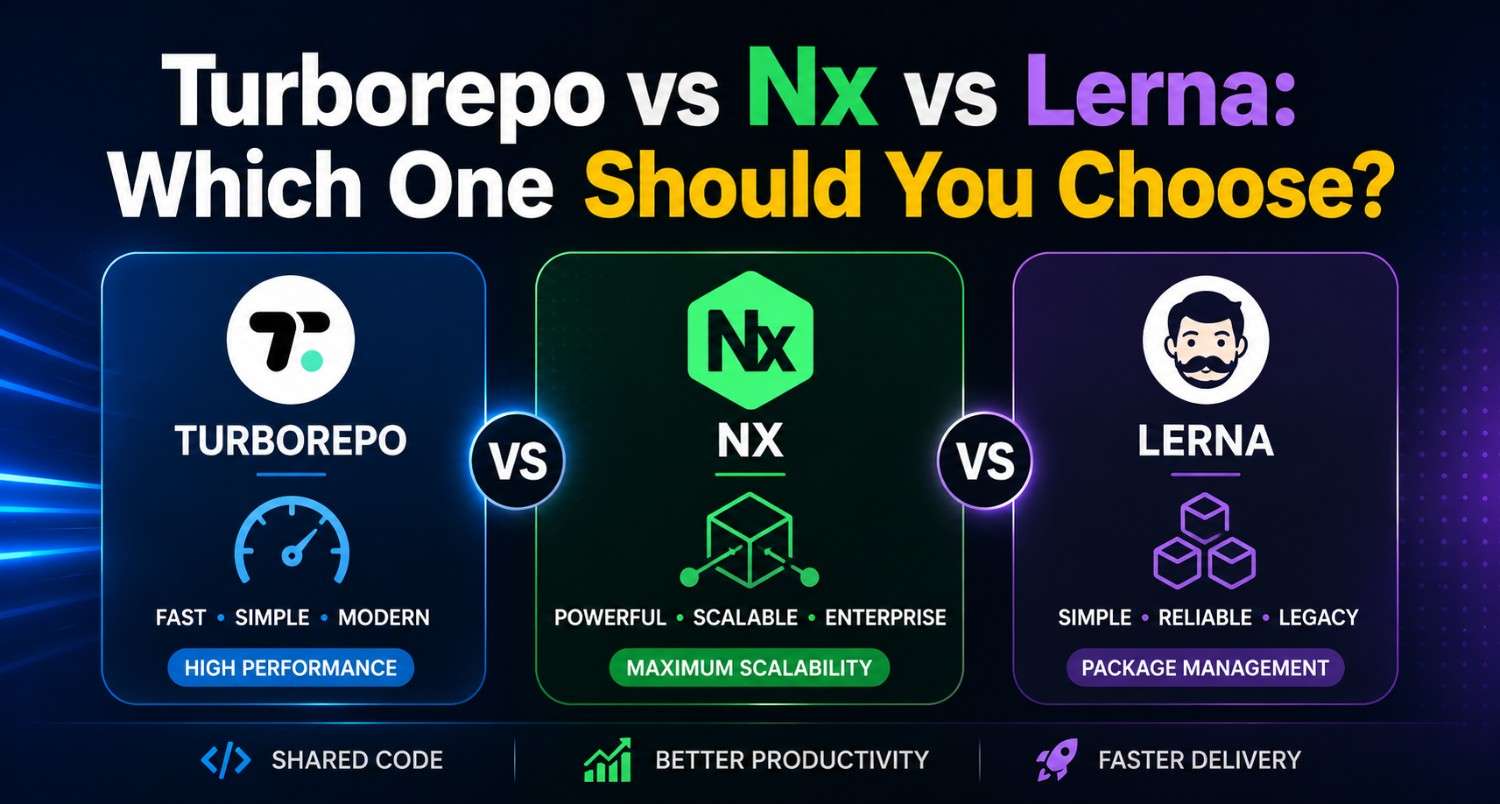
Today, tools like Turborepo, Nx, and Lerna dominate the monorepo ecosystem. But choosing the right one can directly impact your project scalability, developer productivity, and deployment speed.
In this guide by Synarion IT Solutions, we’ll compare Turborepo vs Nx vs Lerna in 2026 and help you decide which solution is best for your development workflow.
What is a Monorepo?
A monorepo (monolithic repository) is a single Git repository that contains multiple projects and packages.
Instead of maintaining separate repositories for:
- Frontend apps
- Backend APIs
- Shared UI libraries
- Utility packages
- Mobile apps
—all code lives in one centralized repository.Common Monorepo Structure

/apps
   /web
   /mobile
   /admin

/packages
   /ui
   /utils
   /config
Companies like Google, Meta, Microsoft, and Uber use monorepos to manage large-scale engineering systems.
Why Monorepos Are Popular in 2026
Monorepos have evolved significantly due to:
- Faster build systems
- Intelligent caching
- Distributed task execution
- Improved package management
- Better CI/CD integrations
Key Benefits
1. Shared Code Reusability
Teams can easily reuse:
- Components
- Hooks
- Utilities
- APIs
- Design systems
This improves consistency across applications.
2. Better Developer Experience
Developers can:
- Work across projects easily
- Share configurations
- Debug faster
- Maintain dependencies centrally
3. Faster Builds with Caching
Modern monorepo tools use advanced caching systems that only rebuild affected projects.
This dramatically improves performance.
4. Simplified CI/CD
Monorepos reduce deployment complexity by centralizing:
- Testing
- Builds
- Versioning
- Releases
What is Turborepo?
Turborepo is a high-performance monorepo build system created by Vercel.
It is especially popular among:
- Next.js developers
- React teams
- TypeScript projects
- Startup engineering teams
Turborepo focuses heavily on:
- Speed
- Simplicity
- Incremental builds
- Remote caching
Advantages of Turborepo
1. Extremely Fast Builds
Turborepo’s intelligent caching minimizes rebuild times by reusing previous outputs.
This makes it one of the fastest monorepo tools available.
2. Excellent Next.js Integration
Since it’s developed by Vercel, Turborepo works seamlessly with:
- Next.js
- React
- Vite
- TypeScript
Perfect for modern frontend ecosystems.
3. Minimal Configuration
Turborepo is easier to set up compared to Nx.
Many developers appreciate its lightweight configuration style.
4. Great Developer Experience
The CLI feels modern and clean, making onboarding faster for teams.
Limitations of Turborepo
Limited Enterprise Features
Compared to Nx:
- Fewer advanced dependency graph tools
- Less enterprise orchestration
- Limited built-in generators
Ecosystem Still Growing
Although rapidly improving, Turborepo’s ecosystem is still smaller than Nx’s enterprise tooling ecosystem.
What is Nx?
Nx is a powerful enterprise-grade monorepo platform designed for large-scale applications.
It supports:
- React
- Angular
- Vue
- Node.js
- NestJS
- React Native
Nx is known for:
- Advanced architecture tooling
- Dependency graph analysis
- Scalable code organization
- Enterprise automation
Advantages of Nx
1. Enterprise-Level Scalability
Nx is ideal for:
- Large engineering teams
- Multi-team collaboration
- Complex architectures
It offers advanced project orchestration features.
2. Smart Dependency Graph
Nx visualizes project relationships, helping developers understand:
- Dependencies
- Impacted builds
- Code ownership
This becomes critical in large codebases.
3. Powerful Code Generators
Nx includes generators for:
- Apps
- Libraries
- APIs
- Components
This speeds up development consistency.
4. Advanced CI Optimization
Nx Cloud enables:
- Distributed builds
- Parallel execution
- Incremental testing
- Smart task scheduling
This significantly improves CI/CD efficiency.
Limitations of Nx
Steeper Learning Curve
Nx introduces:
- More concepts
- More configuration
- More architectural rules
Smaller teams may find it overwhelming initially.
Can Feel Heavy for Small Projects
For lightweight startups, Nx can sometimes feel more complex than necessary.
What is Lerna?
Lerna is one of the oldest monorepo management tools in the JavaScript ecosystem.
Originally focused on:
- Managing multiple packages
- Versioning
- Publishing workflows
Lerna helped popularize monorepos before modern build systems evolved.
Advantages of Lerna
1. Simple Package Management
Lerna works well for:
- Multi-package libraries
- NPM package publishing
- Basic monorepo workflows
2. Mature Ecosystem
Lerna has existed for years and integrates with many JavaScript workflows.
3. Easy Migration Path
Older projects already using Lerna can continue maintaining existing workflows.
Limitations of Lerna
Slower Compared to Modern Tools
Lerna lacks the advanced caching and orchestration systems found in:
- Turborepo
- Nx
Build performance can become an issue at scale.
Fewer Modern Features
Modern monorepo expectations now include:
- Distributed caching
- Incremental builds
- Smart dependency analysis
Lerna alone struggles in these areas.
Turborepo vs Nx vs Lerna: Practical Comparison
| Feature | Turborepo | Nx | Lerna |
|---|---|---|---|
| Performance | Excellent | Excellent | Moderate |
| Learning Curve | Easy | Medium-High | Easy |
| Enterprise Features | Moderate | Excellent | Limited |
| Build Caching | Advanced | Advanced | Basic |
| Dependency Graph | Basic | Advanced | Limited |
| CI/CD Optimization | Strong | Excellent | Moderate |
| Best For | Startups & frontend teams | Large enterprises | Legacy package management |
| Ecosystem | Growing rapidly | Mature enterprise ecosystem | Older ecosystem |
| Configuration Complexity | Low | High | Low |
Which Monorepo Tool Should You Choose?
Choose Turborepo If:
- You use Next.js or React heavily
- Your team wants simplicity
- Speed is a top priority
- You’re building modern SaaS platforms
- You want fast onboarding
Turborepo is currently one of the best choices for modern frontend-focused teams.
Choose Nx If:
- You manage large enterprise applications
- Multiple teams collaborate on shared systems
- You need advanced architecture tooling
- CI/CD optimization is critical
- You want scalable engineering governance
Nx is ideal for enterprise-grade development environments.
Choose Lerna If:
- You maintain older JavaScript monorepos
- You mainly manage packages
- Your architecture is relatively simple
- You want lightweight publishing workflows
However, many teams now combine Lerna with Nx or migrate away from it entirely.
The Future of Monorepos in 2026
The monorepo ecosystem continues evolving rapidly.
Major trends include:
- AI-assisted development workflows
- Remote caching at scale
- Edge deployment optimization
- Full-stack TypeScript architectures
- Incremental builds everywhere
Today, monorepos are no longer limited to large tech companies.
Even startups now adopt monorepo architectures from day one because:
- Collaboration improves
- Shared code becomes easier
- Deployment pipelines become faster
- Product scaling becomes smoother
Final Verdict
There is no single “best” monorepo tool.
Your ideal choice depends on:
- Team size
- Application complexity
- CI/CD needs
- Framework ecosystem
- Long-term scalability goals
Quick Summary
- Turborepo → Best for modern frontend teams and startups
- Nx → Best for enterprise-scale engineering systems
- Lerna → Best for legacy package management workflows
For most modern SaaS and app development companies, Turborepo and Nx are leading the future of scalable monorepo architecture.
As software ecosystems continue growing more interconnected, mastering monorepos is becoming an essential skill for modern development teams.




What do you think?
It is nice to know your opinion. Leave a comment.